Table of Contents
A sturdy workbench vise is the unsung hero of any hobbyist’s workspace—transforming a simple table into a precision workholding station that grips, stabilizes, and empowers your creativity. Whether you’re filing brass for model trains, cutting dovetails for a jewelry box, or bending wire for sculpture, the right vise becomes a third hand that never fatigues. In 2026, the market for sub-$100 bench vises has evolved dramatically, with manufacturing innovations delivering professional-grade features once reserved for industrial tools costing three times as much.
But here’s the challenge: not all budget-friendly vises are created equal. Some sacrifice critical functionality for a lower price tag, while others hide game-changing versatility beneath unassuming exteriors. This comprehensive guide cuts through marketing hype to examine what truly matters when selecting a workholding solution that will serve your hobby for years to come. We’ll explore the engineering principles, material science, and design features that separate disappointing drawer weights from workshop workhorses—ensuring every dollar you invest returns maximum utility and satisfaction.
Top 10 Workbench Vises
Detailed Product Reviews
1. Yost Vises LV-4 Homeowner’s Vise | 4.5 Inch Jaw Width with a 3 Inch Jaw Opening Home Vise | Secure Grip with Swivel Base | Blue

Overview: The Yost LV-4 delivers professional-grade construction in a compact homeowner package. Cast from 30,000 PSI gray iron—three times stronger than conventional cast iron—this vise handles demanding home workshop tasks without the bulk of industrial models. Its 4.5-inch jaw width and 3-inch opening accommodate most DIY projects, from woodworking to light metal fabrication.
What Makes It Stand Out: The 240° swivel base provides excellent positional flexibility without sacrificing stability, while the generous 2.6-inch throat depth offers surprising reach for its size. The integrated 3.5" x 2.7" anvil provides a solid striking surface for forming and shaping tasks. Yost’s commitment to quality shines through with precision-machined serrated jaws that maintain grip under pressure and a smooth-operating main screw that resists binding.
Value for Money: Priced competitively for the homeowner market, the LV-4 punches above its weight class. The 30,000 PSI casting rivals specifications of vises costing twice as much, and lifetime technical support adds long-term value. While mounting hardware isn’t included, the vise’s durability eliminates frequent replacement costs common with budget alternatives.
Strengths and Weaknesses:
- Strengths: Exceptional casting strength, smooth operation, stable swivel base with secure locking mechanism, integrated anvil, reputable brand with lifetime support, compact footprint for small workshops
- Weaknesses: Limited 3-inch jaw opening restricts larger workpieces, mounting hardware not included, 240° rotation (not full 360°), serrated jaws may mar delicate materials without padding
Bottom Line: The Yost LV-4 is an outstanding entry-level vise for serious DIYers who prioritize durability over maximum capacity. Its robust construction and smooth operation make it ideal for home workshops where space is limited but quality cannot be compromised.
2. VEVOR Bench Vise, 6-inch Jaw Width 5.9-inch Jaw Opening, 360-Degree Swivel Locking Base Multipurpose Vise w/Anvil, Heavy Duty Ductile Iron Workbench Vise w/Bolts & Nuts, for Drilling, Pipe Cutting

Overview: VEVOR’s 6-inch bench vise targets users needing industrial capacity without the premium price tag. Forged from 60,000 PSI ductile iron with a powder-coated finish, this workhorse generates 4,496 pounds of clamping force across its 5.9-inch jaw opening. The full 360° swivel base and included mounting hardware create a ready-to-work package for serious metalworking and fabrication.
What Makes It Stand Out: The complete accessory kit sets this vise apart—magnetic jaw pads protect delicate workpieces while the comprehensive bolt set enables immediate installation. Its dual-function jaw securely clamps both flat stock (up to 5.9 inches) and pipes (0.6"-2.9" diameter), eliminating the need for separate pipe jaws. The 2.9" x 3" anvil provides ample surface for shaping tasks.
Value for Money: This vise delivers remarkable value, offering specifications comparable to $200+ professional models at a fraction of the cost. The 60,000 PSI rating and 360° rotation typically command premium pricing, while included accessories save an additional $30-50 in separate purchases. For budget-conscious buyers needing maximum versatility, it’s nearly unbeatable.
Strengths and Weaknesses:
- Strengths: High 60,000 PSI ductile iron construction, full 360° rotation, massive clamping force, comprehensive accessory kit, dual flat/pipe jaw functionality, large anvil surface, rust-resistant powder coating
- Weaknesses: Heavier weight reduces portability, budget brand may have quality control inconsistencies, powder coating can chip under heavy use, handle grip less ergonomic than premium brands
Bottom Line: The VEVOR 6-inch vise is a cost-effective powerhouse for home shops and light professional use. Its impressive capacity and included accessories make it ideal for users who need maximum functionality without breaking the bank, though tradesmen may prefer established brands for daily abuse.
3. Work IQ Tools 360° Rotating Bench Vise with 5" Jaw Pads - Versatile Woodworking & Pipe Vise for Home Improvement Projects - Compatible with Work Table Workbenches & IQ Connect Accessories

Overview: The Work IQ Vise revolutionizes traditional vise design with its articulating ball-and-socket system, enabling infinite positioning beyond conventional swivel bases. Constructed from hardened steel components and lightweight cast aluminum, this 5-inch vise delivers 130 ft-lbs of torque while remaining portable. It’s engineered for modern makers who prioritize flexibility and accessory integration.
What Makes It Stand Out: The true 360° articulating movement with Quick Cam locking allows positioning at any conceivable angle, not just horizontally. Innovative double-sided jaw pads feature textured rubber for woodworking on one side and grooved profiles for pipe gripping on the reverse. The IQ Connect ecosystem compatibility transforms the vise into a workstation hub, integrating lights, magnifiers, and phone holders directly into the tool.
Value for Money: While priced higher than basic vises, the Work IQ justifies its premium through genuine innovation. The articulating head eliminates workpiece repositioning time, and the accessory ecosystem adds functionality impossible with traditional vises. For tech-savvy DIYers and content creators, the integrated phone holder alone adds significant value for project documentation.
Strengths and Weaknesses:
- Strengths: Infinite angle positioning, lightweight yet strong construction, reversible jaw pads for multi-material use, IQ Connect accessory ecosystem, excellent for content creators, Quick Cam locking system
- Weaknesses: Lower clamping force than heavy-duty vises, cast aluminum may flex under extreme loads, premium pricing, accessory ecosystem requires additional purchases, less suitable for heavy metal forging
Bottom Line: The Work IQ Vise is a forward-thinking tool for modern workshops where flexibility and documentation matter as much as raw power. It’s perfect for woodworkers, DIY content creators, and hobbyists who value innovative design over traditional brute strength.
4. Pony Jorgensen 27091 Medium Duty Woodworker’s Vise, Orange, Grey, 9-Inch By 7-Inch

Overview: The Pony Jorgensen 27091 is a purpose-built woodworker’s vise designed for face-mounting on wood workbenches. With its 9-inch by 7-inch dimensions, this medium-duty tool targets serious woodworkers needing secure, stable workholding for hand tool operations. The orange and grey color scheme reflects its professional heritage while maintaining visibility in busy shops.
What Makes It Stand Out: Unlike metalworking vises, this model features wood-specific design elements optimized for securing workpieces without marring. The face-mount configuration integrates seamlessly into traditional workbench designs, providing rock-solid stability without base flex. Pony Jorgensen’s reputation for medium-duty excellence ensures smooth operation and reliable grip for planing, sawing, and chiseling tasks.
Value for Money: As a specialized woodworking tool, it offers fair value for its intended purpose. The medium-duty classification keeps costs reasonable while delivering adequate performance for most furniture and cabinet projects. However, limited specifications in the product description make direct comparison difficult, suggesting buyers should verify jaw opening capacity before purchasing.
Strengths and Weaknesses:
- Strengths: Purpose-built for woodworking, stable face-mount design, reputable brand heritage, professional color scheme, suitable for medium-duty applications, integrates cleanly into wood benches
- Weaknesses: Extremely limited feature details provided, not suitable for metalworking, face-mount only (no swivel), unknown jaw opening capacity, no mention of construction material or clamping force, minimal product information reduces buyer confidence
Bottom Line: The Pony Jorgensen 27091 serves woodworkers seeking a traditional face-mount vise from a trusted brand. However, the lack of detailed specifications makes it hard to recommend without further research. Purchase only if you can verify it meets your specific capacity requirements.
5. WORKPRO Dual Jaws Table Vise 2.5" & 1.5", 360° Swivel Clamp-On Bench Vise for Woodworking, Metalworking, DIY, Multi-position Small Portable Vise, Mini Vice Clamp for Workbench, Golf Club Regripping

Overview: The WORKPRO Dual Jaws Vise redefines portability and versatility in a compact package. Weighing just 7.7 pounds, this mini vise features two distinct jaw sets—2.5-inch serrated and 1.5-inch smooth—enabling both aggressive metal gripping and delicate workpiece holding. Its 360° swivel head and clamp-on design make it ideal for mobile technicians, hobbyists, and golf club repair specialists.
What Makes It Stand Out: True dual-functionality separates this from other mini vises. The serrated jaws generate 660 pounds of clamping force for metalworking, while the smooth jaws gently secure wood, plastic, or finished surfaces without damage. The clamp-on base attaches to any table or bench up to 2 inches thick in seconds, eliminating permanent mounting. Golf club regripping capability demonstrates its precision and gentle touch.
Value for Money: This vise delivers exceptional versatility per dollar. Competing products offer either metal or wood capability, but rarely both in one unit. The portability factor adds value for users without dedicated workshops. While not suitable for heavy-duty tasks, its specialized design justifies the price for target applications like hobby work, repairs, and craft projects.
Strengths and Weaknesses:
- Strengths: Ultra-portable at 7.7 lbs, dual jaw sets for multi-material use, 360° rotation, tool-free clamp-on mounting, excellent for small precision work, golf club regripping capability, hardened steel jaws (52-58 HRC)
- Weaknesses: Limited 2.5-inch jaw capacity, lower clamping force than full-size vises, clamp-on design less stable than bolted mounting, not suitable for heavy forging or large projects, handle grip could be more ergonomic
Bottom Line: The WORKPRO Dual Jaws Vise is a specialist tool that excels in portability and versatility for light-duty applications. It’s perfect for hobbyists, mobile repair technicians, and anyone needing a vise that can travel. Don’t expect heavy-duty performance, but for its intended uses, it’s exceptionally capable and convenient.
6. Bench Vise, 4-1/2" Table Vise For Workbench,2-in-1 Multi-Purpose Heavy Duty Bench Vice With Multifunctional Soft Jaws, 270° Swivel Base Home Vise for Woodworking,Home Workshop,Welding and DIY

Overview: This versatile 4.5-inch bench vise targets DIY enthusiasts and home workshop users seeking flexibility without permanent installation. Weighing just 13 pounds, it offers a 3.3-inch jaw opening and innovative dual-mounting options. The 270-degree swivel base and forged steel construction make it suitable for woodworking, light welding, and craft projects where portability matters more than industrial-grade force.
What Makes It Stand Out: The 2-in-1 mounting system distinguishes this vise—clamp it directly to benches up to 2.3 inches thick or permanently bolt it down. The multifunctional soft jaws protect delicate workpieces, while the 270-degree rotation eliminates repositioning. The three-year unconditional replacement warranty provides exceptional confidence for a budget-friendly tool, addressing quality concerns proactively.
Value for Money: Positioned as an entry-level solution, this vise delivers impressive versatility for under $100. Comparable vises often lack the clamp-on feature or swivel capability at this price point. While not matching professional-grade clamping force, the forged steel build and warranty make it a smart investment for hobbyists who prioritize adaptability over maximum pressure.
Strengths and Weaknesses: Strengths: Tool-free clamp-on installation; protective soft jaws included; 270-degree swivel range; forged steel durability; excellent 3-year warranty; lightweight portability.
Weaknesses: Limited 3.3-inch jaw opening restricts larger stock; 13-pound weight may shift under heavy hammering; unspecified clamping force likely modest; base clamp less stable than bolted mounting.
Bottom Line: Ideal for DIYers and hobbyists needing a flexible, non-permanent solution. The clamp-on design and swivel function excel in shared or limited spaces. However, serious woodworkers or metalworkers should invest in heavier-duty alternatives. For light-to-medium home use, it’s a practical, well-backed choice.
7. WORKPRO Bench Vise, 4-1/2" Vice for Workbench, Utility Combination Pipe Home Vise, Swivel Base Bench for Woodworking

Overview: WORKPRO’s 4.5-inch combination vise balances home-workshop affordability with professional-inspired features. Constructed from gray iron, it handles both flat stock and pipes through its multi-jaw design. The 240-degree swivel base and substantial anvil area accommodate various clamping needs, delivering up to 2,204 pounds of force for woodworking and light metalworking tasks.
What Makes It Stand Out: The intelligent multi-jaw configuration grips diverse materials without surface damage, a rarity in this class. The generous 2-11/32-inch throat depth and integrated anvil surface extend functionality beyond simple clamping. WORKPRO’s 240-degree locking swivel provides practical positioning flexibility while maintaining base stability—perfect for users who frequently adjust work angles.
Value for Money: This vise hits the sweet spot between cheap cast-iron models and professional units. Priced competitively for its feature set, the combination pipe/flat jaw system eliminates needing separate vises. While gray iron isn’t as robust as ductile iron, the overall construction quality and thoughtful design deliver reliable performance that justifies the moderate investment for serious hobbyists.
Strengths and Weaknesses: Strengths: Versatile multi-jaw design; 240-degree swivel base; integrated anvil work surface; stable mounting; 2,204 lbs clamping force; good throat depth; easy installation.
Weaknesses: Gray iron less durable than ductile alternatives; 240-degree rotation (vs 360°) limits some positions; no quick-release mechanism; pipe jaws may wear with heavy use.
Bottom Line: A solid mid-range choice for home workshops and small garages. The combination jaw design adds real value for users working with mixed materials. While not industrial-grade, it outperforms basic import vises. Recommended for serious DIYers who need reliability without professional pricing.
8. VEVOR Bench Vise 6 Inch, Double Swivel Rotating Heavy Duty Vise Head/Body Rotates 360°,Pipe Vise Bench Vices 30Kn Clamping Force,for Clamping Fixing Equipment Home or Industrial Use

Overview: VEVOR’s 6-inch bench vise positions itself as a heavy-duty solution for demanding users. Built from ductile iron with 30kN (approximately 6,700 lbs) clamping force, it features a unique double-swivel design—both head and base rotate 360 degrees independently. The 5-inch jaw opening and 3-inch throat depth accommodate substantial workpieces for industrial or advanced home applications.
What Makes It Stand Out: The dual 360-degree rotation system provides unmatched positioning freedom, allowing users to access any angle without releasing the workpiece. Precision-machined lead screws and guide rails ensure smooth operation under maximum load. The grooved jaws excel at gripping pipes and irregular shapes, while the ductile iron construction withstands professional workshop abuse that would destroy lesser vises.
Value for Money: For its capabilities, this vise undercuts professional brands by hundreds of dollars. The 6-inch capacity and true 360° versatility rival vises costing twice as much. While VEVOR’s quality control can be inconsistent, the feature-to-price ratio is exceptional. Industrial users on a budget and serious hobbyists upgrading from smaller vises will find tremendous value here.
Strengths and Weaknesses: Strengths: True 360° head and base rotation; massive 30kN clamping force; ductile iron durability; 6-inch jaw capacity; precision-machined components; excellent pipe gripping; industrial-grade construction.
Weaknesses: Bulkier and heavier (weight not specified); mounting requires robust bench; potential quality control variations; overkill for light DIY tasks; higher price point than casual users need.
Bottom Line: A powerhouse vise for users who need maximum versatility and clamping force. The dual rotation is genuinely useful for complex work. Recommended for industrial settings, serious metalworkers, and advanced home shops. Casual users should consider smaller options, but for heavy-duty demands, it’s an exceptional value.
9. PONY 4 Inch Heavy Duty Bench Vise 4400LBS Clamping Force, Pro Workshop Workbench Vise with 360-Degree Rotatable Base and Anvil, 4-Inch Jaw Opening and Width for Woodworking, Drilling, Pipe Cutting
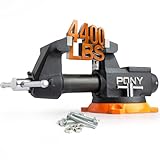
Overview: PONY’s professional-grade 4-inch vise delivers an impressive 4,400 lbs of clamping force in a compact footprint. Engineered for pro workshops, it features a 360-degree swivel base, replaceable pipe jaws, and a dedicated anvil surface. The ductile iron construction (6000 PSI tensile strength) and dustproof enclosed rear design ensure longevity under continuous use for woodworking, metal fabrication, and precision drilling tasks.
What Makes It Stand Out: The fully enclosed rear prevents dust and debris intrusion, a critical feature for longevity that competitors often overlook. The combination of extreme clamping force (4,400 lbs) and smooth 360° rotation in a 4-inch vise is rare. Replaceable jaws extend service life indefinitely, while the U-shaped steel guide bar ensures consistent, wobble-free operation even after years of heavy use.
Value for Money: Priced in the professional tier, this vise justifies its cost through durability and performance. The 4,400-lb rating matches vises costing significantly more from premium brands. For professionals who rely on their tools daily, the dustproof design and replaceable jaws translate to lower lifetime costs. Home users may find it overbuilt, but serious enthusiasts appreciate the “buy once” quality.
Strengths and Weaknesses: Strengths: Massive 4,400-lb clamping force; 360° smooth rotation; dustproof enclosed design; replaceable jaws; premium ductile iron; integrated anvil; professional build quality; includes mounting hardware.
Weaknesses: Premium pricing; 4-inch opening limits larger stock; heavy (weight not specified) for portable use; may be overkill for casual DIY; base lock could be more robust.
Bottom Line: A true professional tool that earns its place in demanding workshops. The dustproof design and replaceable components ensure decades of service. Ideal for serious woodworkers, metalworkers, and professionals who need maximum reliability. Worth the investment if you use a vise daily; hobbyists can find better value elsewhere.
10. IRWIN Tools Woodworker’s Vise, 6 1/2", 226361

Overview: IRWIN’s 6.5-inch woodworker’s vise is purpose-built for woodworking precision. Unlike multi-purpose vises, it features toe-in jaws that concentrate clamping pressure at the top, preventing workpiece slippage. The forged iron body allows mounting wooden jaw faces to protect delicate wood stock, while the 4.5-inch jaw capacity handles typical furniture and cabinetry components. Designed for permanent under-bench installation, it prioritizes control over maximum force.
What Makes It Stand Out: The toe-in jaw geometry is a woodworking-specific feature rarely found on general-purpose vises, ensuring pieces don’t shift during planing or sawing. The provision for custom wooden cheeks allows users to create perfectly matched jaw surfaces for any project. Its square-body design sits flush under workbenches, maximizing legroom and keeping the mechanism protected from debris—ideal for dedicated woodworking stations.
Value for Money: This specialized vise offers excellent value for woodworkers who’ve been using generic metalworking vises. The forged iron construction and thoughtful design details justify the moderate price premium over basic imports. While it lacks pipe jaws and swivel bases, it excels at its intended purpose. For mixed-material shops, you’ll need a second vise, but for pure woodworking, it’s optimally designed.
Strengths and Weaknesses: Strengths: Toe-in jaws prevent slippage; wooden cheek provision protects work; forged iron durability; clean under-bench mounting; 6.5-inch size handles large panels; purpose-built for woodworking tasks.
Weaknesses: No pipe jaws or swivel base; limited to woodworking; 4.5-inch opening smaller than some 6.5" vises; requires permanent installation; no anvil surface; clamping force unspecified but moderate.
Bottom Line: Essential for dedicated woodworkers who value workpiece protection and precision. The toe-in design and wooden cheek capability make it superior to generic vises for furniture making. Not versatile enough for metalworking, but that’s not its purpose. Highly recommended as a primary vise for woodworking shops, and worth every penny for its specialized excellence.
Why Every Hobbyist Needs a Quality Bench Vise Under $100
The moment you attempt to hand-file a small metal part without secure workholding, you realize why a vise isn’t optional—it’s fundamental. A proper bench vise does more than simply hold objects; it provides the stable foundation that determines the accuracy of every subsequent operation. For hobbyists working in limited spaces with constrained budgets, the sub-$100 category represents a sweet spot where legitimate capability meets affordability. These vises won’t match the tonnage ratings of $400 machinist’s vises, but they deliver precisely the clamping force, precision, and versatility that jewelry makers, scale modelers, electronics tinkerers, and woodworking enthusiasts actually need. The key is understanding which specifications matter for your specific applications and which are marketing fluff designed to obscure quality deficiencies.
Understanding Workbench Vise Types for Hobby Applications
Before diving into specifications, you must recognize the fundamental categories of vises competing for your attention. Each type serves distinct purposes, and many hobbyists eventually own multiple vises for different operations.
The Versatile Bench Vise: Your Primary Workholding Solution
The traditional bench vise mounts directly to your workbench and serves as your daily driver. These feature stationary jaws and a movable jaw operated by a threaded screw mechanism. For hobbyists, a 4-inch jaw width typically provides the ideal balance between capacity and bench space consumption. The best models in this category under $100 now incorporate ductile iron castings rather than gray iron, providing 30-40% more tensile strength—a critical upgrade that prevents catastrophic jaw breakage when you inevitably over-tighten during an ambitious project.
Clamp-On Vises: Portable Power for Small Spaces
Clamp-on vises attach to any table edge without permanent mounting, making them perfect for apartment dwellers or those who work at the kitchen table. Modern designs have eliminated the flex and slop that plagued earlier generations. Look for models with dual clamping screws spaced at least 6 inches apart—this configuration distributes load and prevents the vise from rotating under torque. The trade-off is typically reduced throat depth and lighter construction, but for electronics repair, small-scale jewelry work, or plastic model assembly, these limitations rarely matter.
Specialty Vises: When Your Hobby Demands Something Specific
Panavise-style circuit board holders, miniature pin vises for watchmaking, and articulated arm vises for carving represent niche solutions that excel within their limited domains. While these rarely serve as primary workholding for general hobby work, they complement a standard bench vise beautifully. The 2026 market has seen an explosion of hybrid designs that incorporate elements from multiple categories, such as bench vises with removable clamp-on bases or integrated PCB holders built into the stationary jaw.
Key Features That Define Value in Sub-$100 Vises
Value isn’t about finding the cheapest option—it’s about maximizing capability per dollar spent. In the under-$100 segment, manufacturers make calculated decisions about where to invest material and engineering resources. Smart buyers recognize these trade-offs and select vises where corners haven’t been cut in areas critical to their specific needs. The most valuable vises prioritize jaw parallelism under load, smooth screw operation without binding, and base stability that doesn’t require shop-floor reinforcement. Features like polished chrome handles or decorative castings might look impressive in product photos but add zero functional value. Instead, focus on the substance beneath the surface: thread pitch, slide bar thickness, and the presence of replaceable jaw inserts.
Jaw Width and Opening Capacity: Matching Vise to Project
Jaw width determines the maximum stable gripping surface, while opening capacity defines how large an object you can accommodate. For hobbyists, a 3.5 to 4.5-inch jaw width offers the best versatility. Wider jaws distribute clamping pressure more evenly, preventing damage to delicate workpieces, but excessively wide jaws (5+ inches) consume valuable bench real estate and often indicate a vise designed for automotive work rather than precision hobby applications.
Opening capacity requires careful evaluation. Many budget vises advertise 4-inch openings but achieve this through extended screw lengths that introduce flex and reduce rigidity. The effective opening capacity—the distance at which the vise still maintains rigid jaw alignment—often proves 30% less than advertised. For most hobby work, a true 3-inch opening capacity suffices. Model makers rarely need more than 2 inches, while small-scale woodworkers benefit from 3.5 inches for gripping drawer sides or small panels.
Throat Depth: The Hidden Specification That Matters
Throat depth, the distance from the top of the jaws to the slide mechanism, critically impacts your ability to work on deep objects. A shallow throat forces you to position workpieces awkwardly, compromising stability. For under $100, expect 2.5 to 3 inches of throat depth—adequate for gripping the edge of a 1x6 board or holding a project box for electronics work. Some manufacturers artificially inflate this spec by measuring to the screw rather than the slide, a deceptive practice you can expose by examining product photos for the actual jaw support structure. The best value vises in this price range feature boxed slides that extend throat depth without sacrificing rigidity, a design borrowed from higher-end machinist’s vises.
Material Matters: Cast Iron, Steel, and Beyond
The metallurgy of a budget vise determines its longevity and failure mode. Gray iron, the traditional casting material, offers excellent vibration damping and machinability but fractures suddenly when overloaded—potentially launching your workpiece across the room. Ductile iron, increasingly common in sub-$100 vises, provides steel-like toughness and yields rather than shatters under extreme stress. This safety margin alone justifies seeking out ductile iron construction.
Steel components in critical wear areas signal quality. Hardened steel jaw inserts prevent the grooved patterns from deforming under pressure, maintaining positive grip on round or irregular objects. Chrome-plated screw threads resist corrosion that causes binding, while bronze or oil-impregnated thrust bearings reduce operating friction by 60% compared to direct metal-on-metal contact. In 2026, several manufacturers have begun offering sintered steel jaw inserts with embedded diamond grit for superior grip on smooth materials—an aerospace technology trickling down to hobbyist tools.
Mounting Styles: Permanent, Portable, and In-Between
Your workspace constraints dictate mounting requirements. Through-bolt mounting to a solid bench top provides maximum stability but commits you to a single location. Four 3/8-inch bolts with washers distribute load and prevent the vise from tearing free when you’re really cranking on a stuck fastener. The bolt pattern matters—look for 6x6 inch spacing or greater to create a stable base triangle.
Clamp-on mounting sacrifices absolute rigidity for flexibility, but modern designs have narrowed this gap. The best clamp-on vises feature not just dual screws but also a third stabilization point—a set screw that bears against the table edge, eliminating the rocking motion that plagues cheaper designs. Some innovative models offer reversible clamping mechanisms that work on tables up to 3.5 inches thick, accommodating everything from IKEA desktops to solid beech workbenches.
Clamping Mechanisms: Screw, Quick-Release, and Hybrid Designs
The heart of any vise lies in its clamping mechanism. Traditional Acme screws with 3 to 4 threads per inch provide massive mechanical advantage—turning a 6-inch handle generates over 1,000 pounds of clamping force. However, this power comes at the cost of speed; opening the vise from closed to full extension might require 40 handle rotations.
Quick-release mechanisms, once rare in budget vises, now appear regularly under $100. These designs feature a split nut that disengages from the screw, allowing instant jaw positioning. The trade-off involves slightly reduced maximum clamping force and the potential for wear in the release mechanism. For hobbyists who frequently change workpiece sizes, this 90% reduction in adjustment time proves invaluable. The most sophisticated hybrid designs combine a quick-release for gross positioning with a fine-thread screw for final clamping pressure—giving you both speed and power.
Swivel Base vs. Fixed Base: Making the Right Rotation Decision
Swivel bases allow 360-degree rotation, letting you position work at ergonomic angles. This feature proves genuinely useful when filing, carving, or performing detail work that requires accessing multiple sides without repositioning the workpiece. However, swivel mechanisms introduce potential flex points and add complexity that can loosen over time.
In the sub-$100 category, evaluate swivel bases critically. The best designs use a large-diameter ring gear (8+ inches) with multiple locking points, creating rigid engagement that feels nearly as solid as a fixed base. Avoid vises with small 4-inch swivel plates and single locking levers—these will wobble and frustrate precision work. For pure vertical clamping operations like drilling or sawing, a fixed base often provides better value, as manufacturers invest the cost savings into thicker castings or better screws. Consider your workflow: if you primarily work on flat bench tasks, skip the swivel and get a better fixed-base vise for the same money.
The Pipe Jaw Advantage: Hidden Versatility in Bench Vises
Many bench vises include integrated pipe jaws—V-shaped grooves machined into the jaw faces beneath the main flat jaws. These allow secure gripping of round stock from 1/8-inch to 2-inch diameter without marring the surface. For hobbyists, this feature transforms a simple bench vise into a tube-bending fixture, a barrel holder for gunsmithing, or a rod-clamping station for electronics projects.
The key lies in the pipe jaw’s design. Shallow V-grooves with 90-degree included angles provide maximum contact on small diameters but lose grip on larger pipes. Deeper 120-degree grooves accommodate a wider range but may not fully contact tiny rods. The best compromise uses stepped grooves—multiple V-profiles at different depths. Some 2026 models feature reversible jaw inserts where one side presents serrated flat jaws and the opposite side shows deep pipe grooves, effectively giving you two specialized vises in one casting.
Anvil Surfaces: More Than Just a Flat Spot
That flat area on the back of many bench vises isn’t just a design artifact—it’s a functional anvil surface for light hammering, bending, and forming operations. In quality vises, this area receives heat treatment to Rockwell 45-50, hard enough to resist deformation from ball-peen hammers yet tough enough not to chip. For hobbyists working with jewelry, this becomes a miniature forming station for shaping soft metals. Electronics enthusiasts use it as a solid surface for staking components or flattening wire.
Evaluate anvil size relative to your needs. A 3x3 inch surface suffices for most hobby applications; larger areas often indicate a vise designed for heavier blacksmithing work that may compromise precision for mass. The anvil’s position matters too—models with elevated anvil surfaces (1/2-inch above the mounting base) allow clearance for your hand when striking, preventing painful knuckle-bench collisions.
Quick-Release Mechanisms: Time-Saving Features for Hobbyists
The evolution of quick-release designs in budget vises represents one of the most significant value improvements in recent years. Traditional cam-actuated releases require significant handle force to engage and disengage, often startling you with a loud snap. Modern lever-actuated designs use over-center locking that requires minimal effort and operates silently.
When evaluating quick-release mechanisms, test for jaw drift—the tendency of the movable jaw to shift position when the mechanism engages. Quality designs incorporate a secondary alignment pin that prevents this drift, maintaining the precise gap you set. Also examine the release lever’s position; side-mounted levers remain accessible when the vise is fully loaded with large workpieces, while rear-mounted levers can become inaccessible. For hobbyists who work on repetitive tasks requiring frequent workpiece changes, a smooth quick-release can save hours over a year of shop time.
Portability Factors: When Your Vise Needs to Travel
Not every hobby happens in a dedicated shop. Clamp-on vises dominate the portable category, but several features enhance mobility without sacrificing capability. Integrated carrying handles, once considered frivolous, now appear on premium budget vises and make transportation between craft fairs, workshops, or outdoor project sites genuinely practical.
Weight becomes a double-edged sword for portable vises. At under $100, a 15-pound vise represents the practical upper limit for frequent carrying, but this mass also provides stability. Innovative designs use hollow castings with internal ribbing to reduce weight while maintaining rigidity—think of it as the monocoque approach from racing car design applied to workholding. Some models feature detachable mounting plates that stay bolted to your various work surfaces, allowing you to quickly move the vise itself between locations without realignment.
Safety Features That Protect You and Your Work
Budget vises should never compromise safety. Replaceable jaw inserts serve a dual purpose: they protect delicate workpieces from serrated jaws and prevent the catastrophic failure mode where worn jaws cause sudden slip-and-release accidents. Look for inserts secured with socket-head cap screws rather than Phillips or slotted screws—these resist cam-out and allow proper torque specification.
Anti-pinch designs in the slide mechanism prevent fingers from getting caught between moving parts when operating the quick-release. Quality vises incorporate spring-loaded covers that automatically shield the slide gap. The handle design matters too; knurled steel provides positive grip but can abrade palms during extended use. Modern ergonomic handles with over-molded rubber reduce fatigue and prevent the handle from becoming a projectile if it loosens—some 2026 models even feature magnetic handle retention that prevents accidental separation.
Maintenance Routines for Longevity Under $100
A $75 vise maintained properly will outlast a $99 vise neglected. The maintenance burden falls into three categories: lubrication, cleaning, and periodic adjustment. The screw threads require light machine oil every 50 hours of operation—or annually for intermittent hobby use. Apply oil with the jaws fully open to distribute it along the entire screw length, then operate the vise through its full range five times to work the lubricant into the nut.
Slide ways accumulate metal filings, wood dust, and grime that accelerate wear. Monthly cleaning with a brass brush (never steel, which scratches the casting) followed by a coat of paste wax creates a self-lubricating surface that repels debris. For vises used in metalworking, magnetic chip guards—simple strips of flexible magnetic material attached to the slide—prevent ferrous particles from embedding in the ways. Annually, check mounting bolt torque; wood benches compress and loosen over time, reducing vise stability and creating dangerous shifting under load.
Common Buying Mistakes Hobbyists Make
The most expensive vise is the one you replace after six months. First-time buyers consistently overestimate their need for jaw opening capacity, purchasing 5-inch vises that dominate their bench yet never clamp anything larger than a 2-inch block. Conversely, they underestimate throat depth, discovering too late that their vise can’t accommodate a 4-inch deep project box.
Another critical error involves mounting surface evaluation. A stunning vise bolted to a 3/4-inch plywood bench transforms into a wobbly frustration generator. The vise is only as rigid as its mounting; budget at least $25 for reinforcing your bench with a 2x6 hardwood underlayment if needed. Buyers also fixate on clamping force ratings—manufacturers love to advertise “2,000 pounds of force!"—while ignoring jaw parallelism. A vise that generates massive force but twists the workpiece due to poor slide geometry destroys more projects than it secures.
Price vs. Value: Understanding the 2026 Market
The sub-$100 vise market in 2026 has stratified into three distinct tiers. At $40-60, you find basic gray iron castings with minimal features—functional but requiring careful selection to avoid lemons. The $60-80 range represents the value sweet spot, where ductile iron construction, quick-release mechanisms, and replaceable jaws become standard. Above $80 up to $100, you encounter vises with premium features like hybrid clamping systems, ergonomic handles, and reversible jaw designs that approach $150 vise functionality.
Understanding this landscape helps you set realistic expectations. A $49 vise won’t have the same screw smoothness as an $89 model, but it may serve your needs perfectly if you work primarily with wood and plastic. The key is matching the vise’s design intent to your applications rather than chasing features you’ll never use. In 2026, tariffs and material costs have compressed the price bands, meaning $80 buys you what $120 purchased three years ago—making this an exceptional time to invest in a quality budget vise.
Future-Proofing Your Vise Purchase for Evolving Hobbies
Hobbies evolve. Today’s electronics tinkering becomes tomorrow’s mechanical keyboard building, which morphs into next year’s CNC conversion project. A vise that serves only your current interest limits your growth. Future-proofing involves selecting features that span multiple disciplines: adequate throat depth for unexpected large projects, replaceable jaws that can be customized for delicate work, and mounting patterns compatible with aftermarket accessories.
Consider the ecosystem. Some vise families offer add-on jaw sets for specific tasks—nylon jaws for gunsmithing, leather-faced jaws for jewelry, and V-block jaws for round stock. Others feature standardized mounting holes that accept third-party workstops, hold-down clamps, or even small anvil attachments. A vise with a 2-inch by 2-inch hole pattern on 4-inch centers provides maximum accessory compatibility. Also evaluate the manufacturer’s support infrastructure; brands offering downloadable CAD files for custom jaw designs demonstrate commitment to the maker community and ensure your vise grows with your capabilities.
Frequently Asked Questions
What size bench vise is ideal for most hobbyist applications?
A 4-inch jaw width provides optimal versatility for the majority of hobby work, accommodating everything from electronic enclosures to small furniture components. This size balances clamping surface area with bench space consumption, leaving room for other tools while providing sufficient grip for light metalworking, woodworking, and plastic fabrication tasks common in hobby shops.
Can a sub-$100 vise really handle metalworking tasks?
Absolutely, provided you select a ductile iron model with at least 2.5 inches of throat depth and replaceable hardened steel jaw inserts. While you won’t match the 5,000+ pound clamping force of industrial machinist’s vises, a quality budget vise delivers 1,500-2,000 pounds of force—more than sufficient for filing, hacksawing, drilling, and light milling operations on stock under 1-inch thick. The key is avoiding gray iron castings that can fracture under shock loads.
How do I prevent my vise from damaging delicate workpieces?
Use jaw covers made from copper, aluminum, or hardwood to distribute clamping pressure. Many hobbyists create custom jaw faces by attaching 1/4-inch thick aluminum plates with double-sided tape, machining shallow grooves for specific projects. For extremely delicate items like model aircraft components or jewelry, consider a secondary pin vise or circuit board holder rather than risking damage in a bench vise.
Is a swivel base worth the extra cost for a hobbyist?
Swivel bases add 20-30% to a vise’s price in the sub-$100 category. If your work involves frequent filing, carving, or detail work where rotating the workpiece saves significant repositioning time, the investment pays for itself within months. For primarily vertical operations like drilling or sawing, allocate that money toward a vise with better screws or thicker castings instead. Many hobbyists start with a fixed-base vise and add a swivel base later if their work evolves.
What’s the difference between a bench vise and a machinist’s vise?
Machinist’s vises feature much tighter tolerances, higher clamping forces, and precision-ground surfaces designed for metalworking accuracy. Bench vises prioritize versatility with features like pipe jaws and anvil surfaces. For hobbyists, a quality bench vise often proves more useful than a budget machinist’s vise, as the latter’s precision suffers at lower price points while the former’s versatility remains intact.
How often should I lubricate my vise?
For intermittent hobby use, apply light machine oil to the screw threads every six months or 50 hours of operation, whichever comes first. The slide ways benefit from paste wax monthly if used weekly. Over-lubrication attracts dust and filings, creating abrasive paste that accelerates wear. A light coating that leaves a satin finish, not a wet film, provides optimal protection.
Can I mount a vise to a portable workbench or folding table?
Only with significant reinforcement. Portable workbenches typically use 3/4-inch particle board tops that flex and compress under vise loads. Add a 2x6 hardwood underlayment spanning at least three bench cross-members, bolted through the entire assembly with fender washers distributing the load. Folding tables require additional diagonal bracing to prevent racking. When in doubt, test the setup by clamping a scrap piece and applying side pressure—any wobble indicates inadequate support.
What’s the most important specification to check before buying?
Jaw parallelism under load trumps all other specs. A vise that maintains parallel jaws when clamping a 2-inch block will hold work securely without marring or slipping. Unfortunately, this spec rarely appears in product listings. Evaluate it by reading user reviews focusing on precision work, or purchase from retailers with generous return policies. A vise that fails this test is useless regardless of its other features.
Are quick-release mechanisms reliable in budget vises?
Modern quick-release designs have proven remarkably durable, with many hobbyists reporting decade-long lifespans. The key is selecting models where the release mechanism operates independently of the primary clamping force path. In quality designs, the quick-release only positions the jaw; final clamping occurs through the traditional screw threads. Avoid vises where the quick-release bears load during clamping, as these wear prematurely.
How do I know when it’s time to replace my vise rather than repair it?
Replace your vise when jaw parallelism degrades beyond adjustment—typically indicated by visible jaw misalignment when clamping a straight edge. Also consider replacement if the main casting develops cracks, the screw threads show significant wear (more than 0.01-inch play), or replacement parts become unavailable. For hobbyists, a quality vise should last 15-20 years with proper maintenance; if yours fails sooner, the initial purchase likely prioritized price over quality.
See Also
- 10 Best Value Pipe Clamps for DIY Workbench Builds Under $25
- 10 Best Value Workbench Kits for First-Time Builders in 2026
- 10 Best Value Workbench Kits Under $300 for Beginners in 2026
- 10 Best Value Workbench Stools with Back Support in 2026
- 10 Best Workbench Vises for Precise Dovetail Sawing That Grip Without Slip