Table of Contents
Let’s be honest—gravity is the sworn enemy of precision measurement tools. One moment you’re taking a critical measurement on the shop floor, and the next, your digital caliper is performing an unplanned impact test against concrete. In drop-prone workshops where metal meets mayhem, traditional calipers survive about as well as a screen door on a submarine. As we move into 2026, the landscape of shock-resistant digital calipers has evolved dramatically, with manufacturers finally bridging the gap between laboratory precision and battlefield durability.
This comprehensive guide cuts through the marketing jargon to explore what truly makes a digital caliper survive the inevitable drops, impacts, and abuses of real-world workshop environments. Whether you’re managing a high-volume production floor, training apprentices in a vocational setting, or simply tired of replacing delicate instruments, understanding the engineering behind shock resistance will save you thousands in replacement costs and countless headaches.
Top 10 Shock-Resistant Calipers
Detailed Product Reviews
1. HFS(R) 0-6" Imperial Calipers; 4 Way Dial Caliper 0.001" Shock Proof New; Plastic Case

Overview: The HFS(R) 0-6" Imperial Caliper delivers reliable four-way measurement capability for both home DIY enthusiasts and professional users. Constructed from fine-polished solid hardened stainless steel with a double shock-proof design, this tool promises smooth sliding action and consistent accuracy. Each unit ships fully calibrated and ready for immediate use, covering inside, outside, depth, and step measurements with 0.001" divisions and impressive 0.0005" repeatability.
What Makes It Stand Out: The double shock-proof mechanism sets this caliper apart from budget alternatives, protecting the delicate internal gears from workshop mishaps. The 0.0005" repeatability specification exceeds typical entry-level standards, while the included plastic case provides basic protection during storage. Being pre-calibrated eliminates the frustration of initial setup and verification.
Value for Money: Positioned as an entry-level precision tool, this HFS model offers professional-grade features at a hobbyist price point. It significantly undercuts premium brands like Mitutoyo while delivering comparable accuracy for general machining, woodworking, and automotive tasks. The stainless steel construction ensures longevity, making it a smart long-term investment for occasional to moderate users.
Strengths and Weaknesses: Strengths include robust stainless steel build, versatile four-way measurement, excellent repeatability, shock-proof protection, and factory calibration. The plastic case, while functional, feels flimsy compared to the tool’s quality. The brand lacks the legacy reputation of established manufacturers, and the dial face could benefit from better anti-glare coating.
Bottom Line: This caliper excels as a capable, affordable precision instrument for hobbyists and light professional applications. The shock-proof design and pre-calibration add genuine value, making it a recommended choice for those seeking reliability without premium pricing.
2. HFS(R) 0-6" Carbon Steel 4 Way Imperial Dial Caliper .001" Shock Proof

Overview: The HFS(R) Carbon Steel Dial Caliper offers the same versatile four-way measurement capability as its stainless steel sibling but utilizes hardened carbon steel construction. With a 0-6 inch range and ±0.001" accuracy, this tool targets both DIY users and professionals seeking reliable performance. The fine-polished solid hardened carbon steel construction supports smooth operation, while the double shock-proof design protects internal mechanisms from impact damage.
What Makes It Stand Out: The carbon steel construction provides exceptional durability and rigidity, potentially offering superior wear resistance in controlled environments. Like other HFS tools, it arrives fully calibrated and ready for work. The four-way measurement system handles inside, outside, depth, and step dimensions efficiently, making it a versatile addition to any toolbox.
Value for Money: This model typically costs slightly less than its stainless steel counterpart, appealing to budget-conscious buyers. The carbon steel build sacrifices corrosion resistance for economic savings and potentially enhanced durability. For users working in dry, climate-controlled shops who maintain their tools properly, this represents excellent value.
Strengths and Weaknesses: Strengths include robust carbon steel construction, double shock-proof protection, pre-calibrated convenience, and versatile measurement options. However, carbon steel demands diligent maintenance to prevent rust. The accuracy specifications, while adequate, don’t match premium brands. The finish may show wear faster than stainless alternatives.
Bottom Line: Ideal for disciplined users in controlled environments, this carbon steel caliper delivers solid performance at an attractive price. Proper maintenance is essential, but the cost savings and durability make it a worthy consideration for careful DIYers and professionals.
3. Hornady Dial Caliper, 050075-6 Inch Stainless Steel Shock-Resistant Dial Caliper Measuring Tool with Storage Case - Measure Reloading Supplies Inside, Outside, Depth, & Step to .001 Inch Accuracy

Overview: Hornady’s 050075 Dial Caliper brings the company’s reloading expertise to precision measurement. This stainless steel tool delivers 0.001" accuracy across four measurement modes, specifically designed for reloaders measuring case length, bullet diameter, primer pocket depth, and overall cartridge dimensions. The shock-resistant dial mechanism ensures reliability in busy reloading benches, while the included storage case protects the tool between sessions.
What Makes It Stand Out: The Hornady brand carries decades of reloading credibility, giving users confidence in their measurements. The dual-knob design—one for locking measurements and another for zeroing the dial—demonstrates thoughtful ergonomics. The shock-resistant construction withstands the inevitable drops and bumps common in reloading environments, maintaining accuracy over time.
Value for Money: While priced higher than generic imports, the Hornady name justifies the premium for serious reloaders. The specialized focus on ammunition measurement tasks, combined with reliable accuracy and brand support, makes it a worthwhile investment for those demanding consistency in their handloads. Casual users may find better value elsewhere.
Strengths and Weaknesses: Strengths include trusted brand reputation, reloader-specific design, robust shock resistance, convenient dual-knob operation, and protective case. The price premium may deter general users, and the styling is utilitarian rather than sleek. Some users report the dial face could be larger for easier reading.
Bottom Line: This is the go-to caliper for dedicated reloaders who prioritize brand reliability and reloader-focused features. The shock-resistant design and Hornady pedigree make it worth the modest premium for ammunition crafting, though general machinists have more cost-effective options.
4. Dasqua 0-6" Dial Caliper Measuring Tool, Double Shock-Proof, Made of Solid Stainless Steel, Accuracy ±0.00065", Graduation 0.001", Professional High Precision Caliper for Machinists & Woodworking
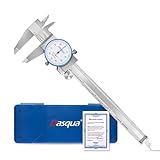
Overview: The Dasqua 0-6" Dial Caliper represents a significant step up in precision engineering, targeting professional machinists and serious woodworkers. With an exceptional ±0.00065" accuracy—substantially tighter than typical 0.001" calipers—this tool delivers laboratory-grade precision in a workshop-hardened package. The solid stainless steel construction features a satin chrome finish for glare reduction, while the hardened glass dial cover resists scratches and impacts.
What Makes It Stand Out: The ±0.00065" accuracy specification positions this caliper in a premium category typically occupied by brands costing twice as much. The double shock-proof technology protects the sensitive mechanism, while the precisely controlled 2.5N-3.5N measuring force ensures repeatable results. Anti-glare and anti-scratch coatings on the hardened glass cover demonstrate attention to professional usability.
Value for Money: Though more expensive than entry-level options, the Dasqua offers true professional precision at a mid-range price. The accuracy rivals instruments costing $200+, making it an exceptional value for machinists, inspectors, and woodworkers requiring consistent, tight tolerances. The durability features ensure long-term reliability.
Strengths and Weaknesses: Strengths include superior accuracy, robust shock-proof design, premium anti-glare coatings, professional measuring force control, and excellent parallelism specifications. The higher price may exceed hobbyist budgets, and the brand lacks the historical prestige of Japanese or Swiss manufacturers. Availability can be limited.
Bottom Line: For professionals demanding premium accuracy without premium pricing, the Dasqua is a standout choice. The ±0.00065" accuracy and professional features justify every penny for serious machining and woodworking applications.
5. HFS(R) 0-6" Stainless Steel 4 Way Imperial Dial Caliper .001" Shock Proof

Overview: This HFS(R) stainless steel dial caliper combines essential precision measurement features with user-friendly enhancements. Offering a 0-6" range with ±0.001" accuracy and 0.0005" resolution, the tool handles inside, outside, depth, and step measurements competently. The finely polished stainless steel construction includes a knurled thumb roller and locking screw for smooth, controlled operation, while the shock-proof design protects against workshop accidents.
What Makes It Stand Out: The 0.0005" resolution provides finer reading capability than standard 0.001" calipers, allowing more precise judgments. The scratch-resistant, anti-glare hard glass cover significantly improves dial visibility compared to basic plastic lenses. The knurled thumb roller offers superior tactile feedback and control during measurement, reducing user error.
Value for Money: This model hits the sweet spot between HFS’s basic and premium offerings, delivering enhanced dial features and better resolution at a modest price increase. It competes favorably with mid-range brands, offering professional touches without the professional price tag. The stainless steel construction ensures longevity, while the improved readability reduces eye strain.
Strengths and Weaknesses: Strengths include excellent 0.0005" resolution, premium anti-glare glass dial cover, smooth knurled thumb roller, robust shock-proof protection, and versatile measurement capability. The brand’s quality control can be inconsistent between batches, and the included case is basic. Some users may prefer digital readouts for absolute clarity.
Bottom Line: A well-balanced choice for users wanting enhanced features without stepping up to premium pricing. The improved resolution and dial clarity make it ideal for detailed work, representing strong value for serious hobbyists and professionals alike.
6. Digital Caliper Measuring Tool, Stainless Steel Vernier Caliper Digital, Micrometer Calipers with Large LCD Screen, Auto-Off Feature, Inch Millimeter Conversion, 6 Inch Caliper Tools for DIY/Household

Overview: The Aurdeayi Digital Caliper is a budget-friendly 6-inch measuring tool designed for DIY enthusiasts and household applications. With a stainless steel body and large LCD display, it delivers measurements at ±0.001-inch accuracy and 0.0005-inch resolution. The tool handles internal, external, depth, and step measurements, making it versatile for various projects around the home or workshop.
What Makes It Stand Out: This caliper’s thoughtful battery management system sets it apart—three included batteries plus insulating sheets let you disconnect power when stored, significantly extending battery life. The 5-minute auto-off feature provides additional power savings, while the quick-change inch/mm button simplifies unit conversion during measurements. The knurled thumb roller and locking screw ensure smooth operation for precise positioning.
Value for Money: Positioned as an entry-level digital caliper, it offers impressive accuracy and resolution for its price point. While it lacks the ruggedness of professional-grade tools, it provides excellent value for occasional users, hobbyists, and homeowners who need reliable measurements without investing in industrial features they’ll never use.
Strengths and Weaknesses: Strengths include the innovative battery preservation system, solid accuracy for DIY tasks, easy unit conversion, and inclusion of spare batteries. Weaknesses are its lack of water or oil resistance, making it unsuitable for harsh workshop environments, and the relatively short 5-minute auto-off period that may interrupt longer measuring sessions.
Bottom Line: An excellent starter digital caliper for hobbyists and DIYers who prioritize affordability and basic functionality. Avoid for professional or industrial applications where durability and fluid resistance are essential.
7. PEC Tools Digital Caliper, 12 Inch/300mm Industrial-Grade Stainless Steel Caliper, IP67 Waterproof & Oil-Resistant, Auto Power-Off, Inch/MM/Fraction Modes

Overview: The PEC Tools Digital Caliper is an industrial-grade measuring instrument built for demanding professional environments. With a 12-inch capacity and IP67-rated protection, this tool delivers ±0.001-inch accuracy while shrugging off water, oil, and coolant exposure that would destroy lesser calipers.
What Makes It Stand Out: Its fully sealed electronics and 4th-generation inductive chip provide unmatched stability in grimy conditions where traditional capacitive sensors fail. The vacuum-quenched stainless steel construction achieves HRC52.5 hardness for exceptional durability. The addition of fraction mode display alongside inch/mm units offers versatility rare in digital calipers.
Value for Money: While commanding a premium price, this caliper justifies every dollar for professionals in machining, automotive, and industrial settings. The IP67 rating alone prevents costly replacements from fluid damage, while the robust construction ensures years of reliable service. For casual users, it’s overkill; for tradespeople, it’s cheap insurance.
Strengths and Weaknesses: Strengths include superior waterproofing, premium hardened steel construction, stable inductive measurement system, comprehensive protective case, and spare batteries. Weaknesses are its higher cost and larger size, which may feel cumbersome for precision electronics work or fine detail measuring.
Bottom Line: A top-tier professional tool that excels in harsh industrial environments. The investment pays dividends through reliability and longevity. Highly recommended for machinists, mechanics, and anyone whose tools face regular exposure to fluids and contaminants.
8. Dasqua 0-8" Dial Caliper Measuring Tool, Double Shock-Proof, Made of Solid Stainless Steel, Accuracy ±0.00085", Graduation 0.001", Professional High Precision Caliper for Machinists & Woodworking

Overview: The Dasqua 0-8" Dial Caliper is a professional-grade mechanical measuring tool engineered for machinists and woodworkers who demand precision without batteries. With an impressive ±0.00085-inch accuracy and 0.001-inch graduation, this shock-resistant instrument delivers reliable measurements in demanding workshop conditions.
What Makes It Stand Out: Double shock-proof technology protects the precision mechanism from drops and impacts that typically damage dial calipers. The hardened glass dial cover features anti-glare and anti-scratch coatings, while the satin chrome finish reduces eye strain during extended use. The dual-knob design allows both measurement locking and easy zero reset without tools.
Value for Money: This mechanical caliper occupies a sweet spot between budget digitals and premium brands. It eliminates battery costs and electronic failures while providing superior accuracy to most entry-level tools. For professionals who prefer analog reliability, it offers excellent long-term value despite its mid-range price.
Strengths and Weaknesses: Strengths include exceptional accuracy, robust shock protection, durable construction, battery-free operation, and user-friendly dual-knob controls. Weaknesses include a steeper learning curve for those accustomed to digital displays, lack of data output capabilities, and no metric version mentioned.
Bottom Line: An outstanding choice for professionals prioritizing mechanical reliability and precision. The shock-proof design and superior accuracy make it ideal for busy workshops where tools face daily wear and tear. Perfect for machinists who trust traditional dial indicators over electronics.
9. Clockwise Tools DDLR-0605 Pro Dial Caliper 0-6 Inch Double Shock Proof Stainless Steel Body SAE Measuring Tool

Overview: The Clockwise Tools DDLR-0605 Pro Dial Caliper is a robust 6-inch mechanical measuring instrument designed for both home DIYers and professionals. With ±0.001-inch accuracy and 0.0005-inch repeatability, this double shock-proof tool provides reliable four-way measurements without electronic vulnerabilities.
What Makes It Stand Out: Each unit ships with a manufacturer calibration certificate, providing documented accuracy assurance rarely included with mid-priced calipers. The fine-polished hardened stainless steel construction ensures smooth sliding and long-term durability. The 1.5-inch dial face offers excellent readability while maintaining a compact profile.
Value for Money: This caliper delivers professional features at a moderate price point. The included calibration certificate adds value and confidence for quality-conscious users. It bridges the gap between budget imports and premium brands, offering certified accuracy without the premium cost.
Strengths and Weaknesses: Strengths include the calibration certificate, effective shock protection, smooth operation, four-way measurement capability, and solid repeatability. Weaknesses are the limited 6-inch range, basic feature set compared to digital alternatives, and smaller dial that may challenge users with vision difficulties.
Bottom Line: A dependable workhorse for serious hobbyists and professionals who need certified accuracy without breaking the bank. The calibration certificate and shock-proof design make it a smart investment for small machine shops and quality control applications where documentation matters.
10. Mitutoyo 505-743J Dial Caliper, 0-8" Range, 0.001" Graduation, 0.1"/Rev, Smooth Dial Movement with Shock Protection, TiN Coated Sliding Surface for Wear Resistance, Lock Screw

Overview: The Mitutoyo 505-743J Dial Caliper represents the gold standard in precision measurement, offering an 8-inch range with 0.001-inch graduation. Renowned in aerospace, medical, and automotive industries, this tool combines Mitutoyo’s legendary quality with titanium nitride coating for exceptional wear resistance.
What Makes It Stand Out: The TiN coating on sliding surfaces dramatically extends caliper life in high-use environments, maintaining precision where uncoated tools quickly wear. Mitutoyo’s redesigned dial movement ensures buttery-smooth operation, while the precision locking mechanism secures both bezel and sliding jaw for repeatable measurements. The satin chrome finish provides glare-free readability.
Value for Money: Commanding a premium price, this caliper justifies its cost through unmatched longevity and reliability. For professionals whose measurements impact critical decisions, the cost is negligible compared to potential errors. It’s an investment that pays dividends over decades of accurate service.
Strengths and Weaknesses: Strengths include superior build quality, TiN wear resistance, smooth operation, industry-leading brand reputation, and comprehensive shock protection. Weaknesses are the premium price point and lack of digital output, which may limit integration with modern data collection systems.
Bottom Line: The ultimate choice for professionals who demand the best. While expensive, its precision, durability, and brand-backed reliability make it worth every penny for critical applications. Accept no substitutes when measurement accuracy directly impacts product quality and safety.
Why Shock Resistance Matters in Modern Workshops
The modern workshop isn’t the controlled environment it once was. Today’s manufacturing floors blend rapid prototyping, 3D printing stations, CNC machining, and collaborative robotics—all high-activity zones where tools get knocked off benches, slip from oily hands, and fall from scaffolding. A standard digital caliper’s delicate internal components simply aren’t designed for this reality.
Shock resistance isn’t just about preventing cracks in the housing. It’s about protecting the sophisticated linear encoders, fragile LCD displays, and intricate circuit boards that make digital measurement possible. When these components misalign or fail after impact, you’re not just losing a $50 tool—you’re compromising measurement integrity across your entire quality control process. In 2026, with tighter tolerances and higher production standards, that risk is unacceptable.
Understanding Drop-Prone Environments
Not all workshop drops are created equal. A drop from a workbench onto a rubber mat differs radically from a fall from three meters onto a steel grate. Drop-prone environments share common characteristics: elevated work surfaces, hard flooring materials, high foot traffic, vibration from heavy machinery, and operators working with gloves or in time-pressured situations.
Consider the automotive technician reaching over an engine bay, the manufacturing engineer measuring on a moving assembly line, or the metal fabricator working on elevated platforms. Each scenario presents unique impact vectors—direct falls, glancing blows, tumbling impacts—that test different aspects of a caliper’s construction. Understanding your specific environment helps prioritize features like corner reinforcement, display protection, or battery housing integrity.
The Evolution of Digital Caliper Durability
The journey from fragile precision instrument to workshop-ready tool has been marked by several technological leaps. Early digital calipers were essentially vernier calipers with electronic readouts bolted on—any impact that would damage a traditional caliper would similarly destroy the digital version. The first generation of “rugged” models simply added rubber boots, which helped with grip but did little to protect internal components.
Today’s fifth-generation shock-resistant designs employ fundamentally different engineering philosophies. We’re seeing monoblock construction where the frame and measuring system are integrated into a single shock-dampening unit. Advanced polymer composites replace traditional stainless steel in non-critical areas to absorb vibration. Internal components are mounted on floating suspensions similar to smartphone gyro-stabilization systems. This evolution means 2026 models can survive impacts that would have rendered 2020 units permanently useless.
Key Shock-Resistant Features to Look For
Reinforced Housing Materials
The outer shell is your first line of defense. Look for calipers featuring glass-fiber reinforced nylon composites or thermoplastic elastomers in impact zones. These materials distribute force across a wider area, preventing concentration points that lead to cracks. Premium models incorporate metal skeletons encapsulated in shock-absorbing polymers, creating a hybrid structure that maintains rigidity while providing cushion.
Pay special attention to corner reinforcement. When a caliper falls, it typically impacts on one of its four corners. Models with thickened corner geometry and energy-dispersing ribs can reduce transmitted shock by up to 60%. Some manufacturers now use finite element analysis (FEA) to optimize these reinforcements, creating structures that buckle in controlled ways to protect internal components.
Impact-Absorbing Internal Components
The real magic happens inside. High-end shock-resistant calipers isolate the measurement encoder—the most critical component—from the outer housing using silicone gel mounts or spring-loaded suspension systems. This decoupling prevents the micro-vibrations and sudden jolts from reaching the fragile glass scale or capacitive sensor array.
Circuit board protection has also advanced significantly. Conformal coatings that were once simple moisture barriers now incorporate elastomeric compounds that allow the board to flex slightly without trace damage. Some designs even segment the circuit into multiple boards connected by flexible ribbons, preventing a single impact from shearing all connections simultaneously.
Advanced Display Protection
The LCD display remains the Achilles’ heel of most digital calipers. Modern shock-resistant models employ polycarbonate lenses with chemically-bonded anti-shatter films—similar to automotive windshield technology. These can flex upon impact rather than cracking. Additionally, some manufacturers now recess the display 1-2mm below the housing surface, creating a protective bezel that takes the hit before the glass does.
Electroluminescent backlighting has largely replaced LED edge-lighting in premium rugged models because it contains no fragile light pipes that can dislodge. The latest innovation involves e-ink displays that are inherently flexible and consume no power when static, though these are still emerging in 2026 and carry a premium price.
IP Ratings and What They Actually Mean for Your Workshop
IP (Ingress Protection) ratings follow a simple format: IP followed by two digits. The first digit indicates solid particle protection (0-6), the second indicates liquid protection (0-9). For drop-prone workshops, IP67 has become the baseline standard, meaning complete dust-tightness and protection against immersion up to 1 meter.
However, the rating doesn’t tell the full story. IP67 testing involves static water pressure and controlled dust exposure—it doesn’t account for dynamic impacts that might compromise seals. For true workshop durability, look for additional certifications like MIL-STD-810H, which includes drop testing from specified heights onto various surfaces. Some manufacturers now publish “IP67+” ratings with supplemental impact data, though this isn’t an official standard.
Consider your specific contaminants. Machine shops produce metal particles finer than dust that can infiltrate standard seals. Foundries expose tools to extreme temperature fluctuations that stress gaskets. Marine environments introduce salt corrosion. The ideal IP rating depends on your particular soup of environmental challenges.
Battery Life Considerations in Rugged Designs
Shock-resistant designs often compromise on battery life. The same robust seals that keep contaminants out make battery compartments difficult to access, leading some manufacturers to opt for non-replaceable rechargeable cells. While convenient, this creates a lifespan limitation—the battery will eventually fail, and you can’t swap it in the field.
Superior designs maintain user-replaceable batteries while using double O-ring seals and threaded battery caps with torque limiters to prevent overtightening. Lithium thionyl chloride batteries have become the gold standard for 2026 rugged calipers, offering 5-7 year shelf lives and stable voltage output across temperature extremes. Avoid models using standard alkaline cells in demanding environments—their voltage sag under cold conditions can cause measurement errors before the battery appears dead.
Some advanced models now incorporate energy harvesting from thumb-wheel rotation, extending battery life by 30-40% in high-use scenarios. This micro-generator charges a capacitor that buffers the main battery, reducing drain during active measurement sessions.
Accuracy vs. Durability: Finding the Sweet Spot
The fundamental tension in shock-resistant caliper design is that precision instruments inherently dislike shock, while durable designs introduce compliance that can compromise precision. The best 2026 models achieve this balance through selective rigidity—making the measurement path extremely stiff while allowing non-critical areas to absorb shock.
Resolution specifications can be misleading. A caliper advertising 0.01mm resolution means nothing if repeatability after impact is ±0.05mm. Look for impact recovery specifications in technical documentation. Premium manufacturers now publish “post-drop accuracy verification” data, showing measurement deviation after standardized drops from various heights.
Remember that absolute accuracy matters less than repeatability in many workshop applications. A caliper that consistently reads 0.02mm off can be compensated for; one that reads randomly different after each drop cannot. Focus on impact recovery and long-term stability specifications rather than just initial accuracy claims.
Ergonomic Design for High-Risk Environments
A tool that fits the hand securely drops less frequently. Modern shock-resistant calipers feature deeply contoured grips with high-friction overmolding. The texture pattern matters—too aggressive and it’s uncomfortable; too smooth and it’s slippery with cutting fluid. Look for variable durometer designs where softer rubber in grip zones transitions to harder material at the ends for protection.
Weight distribution also influences drop frequency. Calipers that are tail-heavy tend to slip from pockets and benches. Forward-weighted designs feel more secure during measurement but can be fatiguing. The sweet spot centers mass at the thumb rest, typically 40% from the tip. Some manufacturers now offer modular weight systems—small tungsten inserts that users can position to customize balance.
Thumb wheel design has evolved beyond simple knurling. Deep-pocketed wheels with finger stops prevent over-rotation and provide tactile feedback even through gloves. The wheel should have enough resistance to prevent free-spinning from vibration but not so much that it causes hand fatigue during repetitive measurements.
Calibration Challenges with Shock-Resistant Models
Traditional wisdom held that any significant impact required immediate recalibration. Modern shock-resistant designs aim to maintain calibration through typical drop events, but this creates a new challenge: how do you know when recalibration is actually needed?
Leading 2026 models incorporate micro-accelerometers that log impact events above a certain G-threshold. When you connect the caliper to its companion app (via Bluetooth or NFC), it displays an impact history and recommends calibration checks based on cumulative shock exposure rather than arbitrary time intervals.
Field calibration has also improved. Many rugged calipers now feature one-touch zeroing that compensates for jaw misalignment, though this isn’t true calibration—it’s just offset adjustment. True calibration requires certified gauge blocks and should be performed after any impact exceeding the manufacturer’s specified threshold, typically marked by a change in the impact indicator status.
Warranty and Support: What to Expect in 2026
The warranty tells you what manufacturers really believe about their product’s durability. Standard digital calipers typically carry 1-year warranties with impact exclusions. True shock-resistant models should offer minimum 3-year warranties with explicit impact coverage.
Read the fine print carefully. Some warranties cover “manufacturing defects” but exclude “damage from misuse,” which they define as any drop. Look for warranties that specifically mention “accidental drop coverage” or “impact protection guarantees.” The best manufacturers offer tiered warranties: full replacement for first-year impacts, then pro-rated coverage for years 2-5.
Support infrastructure matters as much as warranty length. Does the manufacturer offer loaner programs while your caliper is being serviced? Do they provide impact testing data for your specific use case? Can you purchase replacement components like display covers or battery caps? In 2026, leading brands provide digital twins of their calipers—3D models you can integrate into your tool management system for predictive maintenance scheduling.
Price vs. Performance: Budgeting for Resilience
Entry-level shock-resistant calipers start around $75-100 in 2026, but these typically offer basic rubber armor and little internal protection. They survive drops better than standard models but won’t last in truly abusive environments. Mid-range options ($150-250) introduce meaningful internal isolation and better materials, representing the value sweet spot for most workshops.
Premium models ($300-500) incorporate advanced materials, integrated diagnostics, and certified impact ratings. They’re overkill for occasional users but cost-effective for high-abuse environments when you factor in replacement costs and downtime. Consider total cost of ownership: a $400 caliper that lasts 5 years costs less than three $120 calipers that each last 18 months.
Don’t forget hidden costs. Some rugged calipers require proprietary batteries or charging docks. Others need annual factory recalibration to maintain warranty coverage. Factor these into your budget calculations. The cheapest shock-resistant caliper isn’t the one with the lowest sticker price—it’s the one that costs least per measurement over its entire lifespan.
Maintenance Tips for Maximum Longevity
Even the most rugged caliper requires care. Daily cleaning with lint-free cloths prevents abrasive particles from embedding in seals. Weekly inspection of battery cap O-rings for nicks or deformation catches seal failures before they compromise protection. Monthly verification against a known standard (even a simple gauge block) identifies drift before it affects quality control.
Lubrication matters, but not where you think. The measuring faces should remain dry and clean—any lubricant here attracts contaminants and affects accuracy. Instead, apply a single drop of silicone grease to the beam ways every 50 hours of use. This prevents wear without creating a dirt magnet.
Storage is critical. Don’t toss rugged calipers into tool chests where they’ll bang against other tools. Use the included protective case or a dedicated foam cutout. If you must store them loose, retract the jaws completely and lock them—this protects the delicate tips and prevents the beam from acting as a lever during impacts.
Common Mistakes When Choosing Shock-Resistant Calipers
Mistake #1: Overbuying protection level. A foundry worker needs different shock resistance than a woodworking shop. The additional cost and weight of extreme-duty models provide no benefit in low-impact environments.
Mistake #2: Ignoring measurement range. A shock-resistant 6-inch caliper that survives drops is useless if you regularly measure 8-inch parts. Don’t compromise range for durability—manufacturers offer extended-length rugged models.
Mistake #3: Assuming all IP ratings are equal. An IP67 rating achieved through adhesive seals differs from one using mechanical compression seals. The latter survives impacts better because the seal isn’t dependent on bond integrity.
Mistake #4: Neglecting firmware updates. Modern digital calipers contain microprocessors that control measurement algorithms and shock detection. Manufacturers release updates that improve impact recognition accuracy. Treat your caliper like any other smart tool.
Future-Proofing Your Investment
The digital caliper market is evolving rapidly. When investing in shock-resistant models for 2026 and beyond, consider connectivity standards. Bluetooth 5.3 offers better range and lower power consumption than earlier versions. NFC pairing simplifies device management in multi-caliper shops. Some manufacturers are experimenting with ultra-wideband (UWB) for precise tool location tracking.
Modular design represents another future-proofing strategy. Calipers with replaceable measuring jaws, display modules, and battery compartments allow you to upgrade components rather than replacing the entire tool. This approach also simplifies repairs—instead of weeks in the service center, you swap a module in minutes.
Consider data protocol compatibility. As Industry 4.0 matures, your measurement tools need to integrate with quality management systems. Look for calipers that support MTConnect or OPC UA protocols, ensuring they’ll communicate with your existing software infrastructure without expensive middleware.
Frequently Asked Questions
How many drops can a shock-resistant caliper realistically survive before needing replacement?
Quality shock-resistant calipers are tested to survive 50+ drops from 2 meters onto concrete while maintaining accuracy. However, this is cumulative—each impact degrades internal components microscopically. Most manufacturers recommend replacing calipers after 3-5 major impacts or when the impact logger shows cumulative G-force exceeding design limits, typically around 500G total.
Do shock-resistant calipers require special calibration procedures after purchase?
Initial calibration follows the same process as standard calipers using certified gauge blocks. However, post-impact verification differs. Shock-resistant models with integrated accelerometers may require connecting to manufacturer software to reset impact flags after confirming accuracy. This ensures the caliper’s internal compensation algorithms function correctly.
Can I use shock-resistant calipers in extreme temperatures without affecting accuracy?
Premium models rated for -20°C to +60°C maintain accuracy across this range through temperature compensation algorithms. Below -20°C, LCD displays may become sluggish and battery voltage drops, affecting performance. Above +60°C, internal adhesives can soften, potentially compromising impact protection. For extreme environments, look for models with OLED displays and high-temperature battery chemistries.
Are wireless features reliable in shock-resistant designs, or do they compromise durability?
Modern Bluetooth modules are surface-mounted and encapsulated in epoxy, making them more impact-resistant than many mechanical components. Antennas are typically integrated into the housing itself, eliminating fragile external parts. Wireless features don’t inherently compromise durability—in fact, they often reduce wear by eliminating data ports that require physical openings.
What’s the typical lifespan difference between shock-resistant and standard digital calipers in a high-drop environment?
In drop-prone workshops, standard digital calipers average 6-12 months before failure. Quality shock-resistant models typically last 3-5 years under identical conditions—a 4-6x improvement. The break-even point usually occurs around 18 months, factoring in replacement costs and calibration downtime.
How do I verify a manufacturer’s shock resistance claims without destroying the caliper?
Request the manufacturer’s impact testing certification, which should detail drop heights, surfaces, and post-drop accuracy verification. Reputable brands provide this data freely. You can also perform non-destructive verification by checking for visible gap seals, measuring housing flex with moderate pressure, and inspecting the battery compartment for redundant sealing methods.
Will using a protective case negate the need for a shock-resistant caliper?
Cases help but create a false sense of security. They add bulk, slow down measurement workflows, and often get discarded by operators. More importantly, cases don’t protect against impacts during active use—the caliper is most vulnerable when extended and in hand. A truly shock-resistant design integrates protection into the tool itself.
Do shock-resistant calipers weigh significantly more than standard models?
Expect a 15-25% weight increase due to reinforcement materials and sealing. A typical 6-inch shock-resistant caliper weighs 200-250 grams versus 160-180 grams for standard versions. However, ergonomic improvements often make them feel lighter during use because better grip reduces the muscle tension needed to hold them securely.
Can shock-resistant calipers be repaired after major impacts, or are they disposable?
This depends on construction philosophy. Modular designs allow replacement of damaged jaws, displays, and battery compartments. However, if the main beam or encoder system is damaged, repair costs typically exceed replacement value. Most manufacturers offer flat-rate refurbishment programs that restore calipers to factory specifications for 40-60% of new cost.
Are there any trade-offs in measurement speed or feel with shock-resistant designs?
Early ruggedized calipers suffered from “mushy” thumb wheels and sluggish digital response due to overbuilt mechanisms. Modern designs have eliminated these issues through precision bearings and optimized gear ratios. In fact, some 2026 models feel smoother than standard calipers because the internal isolation systems also dampen vibration during measurement, providing a steadier reading.
See Also
- 10 Best Budget Digital Calipers Under $50 for Hobbyists in 2026
- Top 10 Best Digital Calipers for Precision Furniture Making in 2026
- Top 10 Best Digital Calipers for Fine Woodworking Precision in 2026
- 10 Best Value Digital Calipers for Hobbyists Under $50 in 2026
- 10 Digital Calipers with Fraction Displays for Woodworkers in 2026