Table of Contents
Deep relief carving and sculptural hollowing are experiencing a renaissance among contemporary woodworkers, pushing the boundaries of what’s possible with traditional hand tools. As we approach 2026, the demand for gouges capable of removing massive amounts of material efficiently while maintaining surgical precision has never been greater. Deep cuts aren’t just about force—they’re about understanding the delicate interplay between tool geometry, steel composition, and technique. Whether you’re roughing out a life-size portrait panel or excavating the interior of a turned vessel, having the right gouge profile can mean the difference between artistic flow and frustrating resistance.
This comprehensive guide explores the ten essential gouge categories that serious woodcarvers are integrating into their arsenals for aggressive material removal. We’ll dissect the physics behind deep cutting, examine critical features that separate professional-grade tools from hobbyist options, and provide the framework for building a system that matches your specific carving style. No brand names, no sponsored recommendations—just pure, technical knowledge to help you make informed decisions in an increasingly complex marketplace.
Top 10 Wood Gouges
Detailed Product Reviews
1. ATOPLEE 4 Pieces Wood Chisel Set for Woodworking, Professional Wood Chisel Tool Carpenter Gouge CR-V Steel Semi-Circular Edge Sharp Blade 8mm(5/16")/12mm(1/2")/18mm(3/4")/25mm(1") (Full Size-4PCS)

Overview: The ATOPLEE 4-piece chisel set delivers professional-grade semicircular chisels in the most commonly used sizes for woodworking. Each chisel features clearly engraved blade markings for quick identification, eliminating guesswork during project work. The set includes 8mm, 12mm, 18mm, and 25mm widths, providing versatility for trimming, carving, and shaping tasks. With chrome vanadium steel construction and pre-sharpened edges, these tools arrive ready for immediate use.
What Makes It Stand Out: The semicircular edge design distinguishes this set from standard flat chisels, enabling efficient wood chip removal and creating concave cuts with precision. The CR-V steel blades achieve HRC58-62 hardness, offering exceptional edge retention and wear resistance. The solid wood handles feature clamped metal hoops that withstand mallet strikes without deforming—a critical detail often missing in budget sets. The thickened blade body adds durability where it matters most.
Value for Money: Priced in the mid-range for specialty chisel sets, this offering justifies its cost through material quality alone. Individual semicircular chisels of comparable CR-V steel typically retail for $15-20 each, making this four-piece bundle a cost-effective choice. The ready-to-use sharpness saves time and preserves expensive sharpening stones from initial grinding duties.
Strengths and Weaknesses: Strengths: Excellent steel hardness rating; reinforced handles prevent splitting; clear size markings; specialized semicircular profile; pre-sharpened edges; compact essential size range. Weaknesses: Limited to four tools; semicircular design isn’t universally applicable; may require periodic resharpening with heavy use; lacks storage solution; not ideal for fine detail work requiring straight edges.
Bottom Line: This set excels for woodworkers specifically needing semicircular profiles for hollowing and shaping. The build quality surpasses hobby-grade alternatives, making it a smart investment for carpenters and serious DIYers who understand the value of task-specific tools.
2. Dicunoy 12 PCS Wood Carving Tools, Gouges Woodworking Chisels, Full Size Wood Carving Knifes for Beginner, Hobbyists, Professionals, Artistic, Gifts for Him, Father’s Day

Overview: Dicunoy’s comprehensive 12-piece carving set provides an all-in-one solution for woodworkers at any skill level. The collection includes deep gouges, medium and shallow gouges, straight chisels, rounded chisels, angled knives, a parting tool, and a pinpoint tool—covering virtually every carving need. Packaged in a genuine leather carrying bag, this set prioritizes portability and organization while making an impressive visual statement.
What Makes It Stand Out: The sheer variety of tip profiles makes this exceptionally versatile for learning different carving techniques. Unlike sets that force beginners to adapt limited tools, each piece here serves a distinct purpose. The stainless steel hoop-reinforced wooden handles provide durability without sacrificing traditional feel. The gift-ready presentation, complete with leather storage, positions this as a premium offering for special occasions like Father’s Day or birthdays.
Value for Money: With twelve tools averaging under $3-4 each, this set represents remarkable value compared to purchasing individual specialty gouges. Professional-grade single tools often exceed $25 each, making this collection ideal for those exploring carving without major investment. The included leather bag adds $15-20 of value alone.
Strengths and Weaknesses: Strengths: Unmatched variety for technique exploration; pre-sharpened and resharpenable; durable handle construction; professional leather storage; suitable for all experience levels; excellent gift presentation. Weaknesses: Quality consistency may vary across twelve pieces; not all tools will see regular use; requires maintenance knowledge; steel specifications not detailed; compact bag may feel crowded when sheathed.
Bottom Line: Perfect for beginners seeking to experiment with different carving styles or professionals needing a portable secondary set. The diversity and presentation outweigh minor quality inconsistencies, making this the best value for those entering the craft.
3. 8 Pcs Wood Sculpture Carving Chisel Tool Set DIY Art Craft (8)

Overview: This eight-piece sculpture carving set targets hobbyists and artists focused on detail work and three-dimensional carving. With specialized blade profiles including elbow arc knives, bevel knives, and multiple circular blades (7mm, 9mm, 18mm), the set prioritizes shape variety over size range. The compact 147mm total length provides excellent control for intricate work, while the short 25mm handle section demands a different grip technique than standard chisels.
What Makes It Stand Out: The unique blade geometries—particularly the elbow arc and various circular knives—enable sculptural techniques impossible with conventional straight chisels. These specialized profiles excel at creating flowing curves, undercuts, and rounded details in relief carving. The minimalist design focuses entirely on blade function, making this a purpose-built kit rather than a general-purpose collection.
Value for Money: Positioned as a budget-friendly entry point, this set offers shapes rarely found in affordable kits. While steel specifications remain unspecified, the price point (typically under $20) makes it accessible for hobbyists testing sculpture techniques. However, the unknown material quality requires tempering expectations regarding edge retention.
Strengths and Weaknesses: Strengths: Highly specialized blade profiles; compact size enhances control; affordable introduction to sculpture carving; variety of arc radii; lightweight for extended use. Weaknesses: Undisclosed steel grade raises durability concerns; extremely short handles reduce leverage; lacks storage bag or protective covers; minimal product information; not suitable for heavy mallet work.
Bottom Line: Best suited for hobbyists and artists needing specific curved blades for detail work on a budget. Serious carvers should view this as a supplemental set rather than primary tools, but the unique profiles justify the modest investment for experimental sculptors.
4. GREBSTK 4pcs Semicircle Chisel Set Carpenter Gouge Chrome Vanadium Steel Semi-Circular Cr-V Woodworking Carving Chisels

Overview: GREBSTK’s four-piece semicircle chisel set mirrors professional specifications with chrome vanadium steel blades hardened to HRC58-62. The set focuses exclusively on semicircular profiles for efficient wood removal in hollowing and shaping operations. Each tool features an outer cutting edge with a concave groove designed to evacuate chips rapidly, reducing clogging during aggressive cuts. Protective covers and rust-preventative oil coating demonstrate attention to tool preservation.
What Makes It Stand Out: The deliberate chip-removal groove design showcases engineering beyond basic blade shaping. This feature significantly improves workflow efficiency when carving bowls, spoons, or architectural details. The included protective covers for every tip prevents damage during storage—a detail often omitted even in premium sets. The rust-proof oil coating provides immediate protection for steel exposed to workshop humidity.
Value for Money: Competitively priced against similar CR-V semicircular sets, this offering adds value through protective accessories and corrosion prevention. The specialized groove design justifies parity pricing with standard semicircular chisels, while the protective covers extend tool lifespan, reducing replacement costs. For woodworkers regularly using these profiles, the efficiency gains offset the investment.
Strengths and Weaknesses: Strengths: Engineered chip evacuation groove; protective covers included; HRC58-62 hardness rating; rust-preventative coating; sharp beveled edges; suitable for all wood types. Weaknesses: Limited to semicircular profiles; only four sizes; brand recognition lower than established names; requires cleaning oil before first use; no storage case provided.
Bottom Line: An excellent choice for woodworkers who frequently work with concave cuts and value tool protection. The chip-removal design provides measurable workflow improvements, making this a specialized but worthwhile addition to any well-equipped shop.
5. 12 Pieces Wood Chisel Set,Home Wood Carving Tools With Steel Hammer End, Professional Wood Gouge Turning Tools For Craftsman Carpenter Beginners, For Precision Carving & Diy Projects

Overview: This twelve-piece set balances traditional functionality with modern ergonomic design, featuring carbon steel blades and impact-resistant plastic handles. The collection includes sizes from 9.5mm to 12mm, providing subtle graduation for precision work. Each handle incorporates a steel hammer end cap to prevent mallet damage—a practical feature for heavy-handed users. The black canvas storage bag offers safe transport while protecting users from exposed edges.
What Makes It Stand Out: The steel hammer end distinguishes this from wood-handled competitors, eliminating handle splitting concerns entirely. The ergonomic non-slip grip reduces hand fatigue during extended sessions, particularly beneficial for beginners developing technique. The canvas bag’s full-length protection contrasts with open-top rolls, enhancing safety when retrieving tools. The size range, while narrow, focuses on the most frequently used dimensions for detail and joinery work.
Value for Money: The hybrid construction—carbon steel blades with plastic handles—delivers durability at a budget-conscious price point. Twelve tools with protective storage typically under $30 represents strong value for DIYers and entry-level woodworkers. While carbon steel requires more maintenance than CR-V, the cost savings justify the trade-off for non-professional use.
Strengths and Weaknesses: Strengths: Steel hammer ends prevent handle damage; ergonomic non-slip grips; comprehensive canvas storage; good piece count; sharp carbon steel edges; focused size range reduces decision fatigue. Weaknesses: Carbon steel less durable than CR-V alternatives; plastic handles lack traditional appeal; narrow size range limits versatility; unspecified exact sizes beyond examples; may require frequent sharpening.
Bottom Line: Ideal for beginners and DIY enthusiasts prioritizing handle durability and comfort over premium steel. The protective features and ergonomic design make this a practical, worry-free starter set that handles most home woodworking projects competently.
6. Wood Carving Kit, 12 PCS Wood Carving Set - Wood Carving Tools with Canvas Case,Sharp Cr-V 60 Steel Blades, Wood Chisel Sets for Beginners and Professionals

Overview: This 12-piece wood carving kit delivers professional-grade performance for artisans at any skill level. Featuring CR-V 60 steel blades hardened to C60 and painstakingly hand-polished over two months, the set promises exceptional sharpness and longevity. The collection includes a thoughtful assortment of chisels, a shock-absorbing nylon hammer, and a rugged 400D canvas storage pouch, creating a complete workshop solution.
What Makes It Stand Out: The meticulous two-month manual polishing process creates an edge rarely found in factory-produced tools. The octagonal white ash handles prevent rolling while providing superior grip comfort and moisture resistance. The included nylon hammer stands out with its recoil-absorbing properties and 304 stainless steel joints, protecting your chisels from impact damage while transferring force efficiently.
Value for Money: With twelve versatile chisels, a specialized mallet, and a premium storage solution, this set offers remarkable completeness at a competitive price point. The three-year factory warranty provides exceptional long-term value, essentially guaranteeing your investment against manufacturing defects.
Strengths and Weaknesses: Strengths include outstanding blade sharpness, ergonomic handle design, comprehensive tool selection, and industry-leading warranty coverage. The nylon hammer may feel lightweight for traditionalists preferring heavier mallets, and beginners might find the twelve-tool assortment initially overwhelming.
Bottom Line: An outstanding comprehensive carving solution that balances quality, completeness, and peace of mind. Ideal for serious beginners ready to invest in growth and professionals seeking reliable backup tools.
7. LWCUSNJ 12-Piece Wood Carving Chisel Set - CR-V 60 Steel Multi-Shape Edge Gouges Carving tool for Woodworking Beginners and Professionals with Storage Case

Overview: The LWCUSNJ 12-piece chisel set targets woodworkers seeking precision and variety. Each tool features Cr-V 60 chromium-vanadium steel blades heat-treated to 56-61 HRC, ensuring sustained sharpness across diverse conditions. The set includes meticulously specified gouges, chisels, and V-tools ranging from 6mm to 25mm, accommodating detailed relief work to broader material removal.
What Makes It Stand Out: The advanced internal and external fixation design securing blades to handles minimizes loosening—a common failure point in budget sets. The handles emulate walnut wood aesthetics while promising durability. The explicit sizing chart helps buyers understand exactly what profiles they’re getting, eliminating guesswork for precise project planning.
Value for Money: Offering twelve specialized profiles, this set provides excellent versatility for the price. The corrosion-resistant treatment adds value for humid climates, reducing maintenance needs. While lacking a hammer or storage beyond a case, the focus on blade variety makes it ideal for carvers who already own mallets and want to expand their capabilities economically.
Strengths and Weaknesses: Strengths include precise shape selection, secure blade-handle connection, corrosion resistance, and clear specifications. Weaknesses include ambiguous handle material description (“designed to resemble walnut wood”) and no mentioned warranty. The set assumes users own a mallet.
Bottom Line: A specialized, shape-focused set perfect for intermediate carvers needing specific profiles. Best suited as a supplement to existing tools rather than a standalone starter kit.
8. GREBSTK 4pcs Semicircle Chisel Set Carpenter Gouge Chrome Vanadium Steel Semi-Circular Cr-V Woodworking Carving Chisel
Overview: The GREBSTK 4-piece semicircle chisel set serves a specialized niche in woodworking. Crafted from chrome vanadium steel hardened to HRC58-62, these tools feature a unique semicircular profile designed for efficient chip evacuation. With cutting edges ranging from 1/4" to 1", the set excels at hollowing, shaping, and creating concave forms in both soft and hardwoods, particularly in tight corners.
What Makes It Stand Out: The semicircular groove design fundamentally improves waste removal, reducing clogging during deep cuts. The 9.5-inch overall length provides excellent leverage for controlled carving. Each chisel arrives honed and buffed with protective oil and tip covers, ensuring immediate usability while preventing rust during storage.
Value for Money: As a specialized set, it offers strong value for carvers specifically needing semicircular profiles. However, its limited scope means it complements rather than replaces a general-purpose set. The beech handles and Cr-V steel construction deliver durability at a moderate price point for targeted applications.
Strengths and Weaknesses: Strengths include innovative chip-clearing design, ready-to-use sharpness, comfortable beech handles, and comprehensive edge protection. Weaknesses include limited versatility—four tools of similar profile cannot handle diverse carving tasks. The manufacturer acknowledges blades will dull, requiring user honing skills.
Bottom Line: An excellent specialty add-on for experienced carvers focused on hollow-form work. Beginners should prioritize more versatile sets before investing in this focused collection.
9. LWCUSNJ 4-Pieces Woodworking Wood Chisel Set,CR-V Steel Sharp Curved Edge Gouge Firm Wood Handle Carpentry Gouge Tools
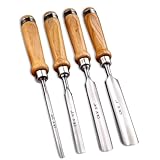
Overview: The LWCUSNJ 4-piece woodworking chisel set offers a minimalist approach to curved-edge carving. Featuring chromium vanadium steel blades in widths from 6mm to 25mm, this collection focuses exclusively on gouge work. The tools arrive presharpened for immediate use, targeting carvers who need basic curved profiles without the complexity of larger sets.
What Makes It Stand Out: The metal reinforcement ring at the handle end provides enhanced durability against mallet strikes—a feature often omitted in budget sets. The straightforward four-size progression covers most common gouge applications, from fine detail to broader material removal. The presharpened edges eliminate initial setup time for quick project starts.
Value for Money: This represents an entry-level investment for those testing wood carving or needing specific gouge sizes. While extremely affordable, the limited selection means purchasers will quickly require additional profiles. It functions best as a supplementary set or ultra-basic starter kit for simple projects.
Strengths and Weaknesses: Strengths include low cost, immediate usability, handle reinforcement, and simple size range. Weaknesses include lack of tool variety (no V-chisels, flats, or skews), absence of storage solution, and minimal product support information. The narrow focus restricts project versatility significantly.
Bottom Line: A no-frills, budget-friendly option for absolute beginners or as a backup gouge set. Serious hobbyists should invest in more comprehensive collections, but this serves as an economical entry point for simple curved cuts and basic carving tasks.
10. Flexcut Carving Tools Deluxe Palm Gouge Set FR405, Wood Crving Kit, Razor-Sharp 1095 High Carbon Steel Blade, Made in the USA

Overview: The Flexcut FR405 Deluxe Palm Gouge Set represents American craftsmanship at its finest. This nine-tool collection features razor-sharp 1095 high carbon steel blades and ergonomic ash hardwood handles designed for hand-held precision work. Housed in an elegant storage box with a lid, the set includes specialized gouges and V-tools sized for detailed carving, whittling, and printmaking applications.
What Makes It Stand Out: As a Made-in-USA product since 1992, Flexcut combines traditional blade metallurgy with modern ergonomic design. The 1095 steel achieves exceptional sharpness and edge retention surpassing most Cr-V alloys. The palm-style ash handles provide unmatched control for fine detail work without mallet fatigue. The luxurious presentation box elevates it as a gift-worthy professional tool.
Value for Money: Positioned at a premium price, this set justifies cost through superior materials, domestic manufacturing, and specialized design. For dedicated carvers prioritizing precision and comfort, the investment pays dividends in reduced hand strain and exceptional edge performance. However, budget-conscious buyers may find equal utility in less expensive imports for basic tasks.
Strengths and Weaknesses: Strengths include outstanding blade steel, ergonomic palm handles, American manufacturing, professional presentation, and immediate razor-sharp readiness. Weaknesses include premium pricing, limitation to hand-powered carving (not mallet-compatible), and fewer pieces than competing sets at similar prices.
Bottom Line: An exceptional choice for serious hobbyists and professionals who value ergonomics and American quality. Ideal for detail-oriented work, though not designed for heavy mallet-driven applications.
Understanding Deep Cut Woodcarving
The Physics of Deep Cuts
Deep cut woodcarving operates on fundamentally different principles than surface detailing. When you’re removing material beyond 1/2 inch, you’re not just slicing fibers—you’re fracturing wood structure and managing massive chip evacuation. The cutting edge must withstand significant lever forces that can snap poorly tempered steel or split handles from their tangs. Understanding rake angle becomes critical; too aggressive and the tool dives uncontrollably, too conservative and you’re essentially pushing wood rather than cutting it. The sweet spot for deep work typically ranges between 25-35 degrees, allowing the edge to bite without grabbing.
Why Standard Gouges Fall Short
Your detail gouges—those lovely sweeps 3-6 you use for facial features and foliage—simply aren’t engineered for heavy stock removal. Their thinner cross-section flexes under mallet blows, causing wandering cuts and potential chipping. The shallow sweeps don’t provide enough curvature to channel chips upward and out of deep recesses, leading to packing that requires constant clearing and increases friction heat. Standard gouges also lack the mass necessary for momentum-driven cutting, forcing you to work harder while achieving less aggressive results.
The 10 Essential Gouge Profiles for Deep Cuts
#1: The Deep U-Gouge (Sweep 9-11)
When you need to remove serious volume from broad areas, the deep U-gouge becomes your primary workhorse. Sweeps 9 through 11 provide the dramatic curvature necessary for carving channels that evacuate chips naturally through gravity and tool movement. Look for blades with thickened spines—often 30% heavier than standard profiles—to prevent flexing during mallet work. The ideal depth-to-width ratio should approach 1:1.5, creating a spoon-like scoop that doesn’t bind in its own cut. For 2026’s carvers, the trend is toward slightly elongated curves that maintain cutting efficiency while reducing the “chatter” common in traditional deep U-gouges.
#2: The Aggressive V-Tool (60-90 Degrees)
Forget the delicate 45-degree V-tools used for decorative lines. Deep cut V-tools feature dramatically steeper angles between 60 and 90 degrees, creating a tool that splits wood rather than slicing it. These profiles excel at establishing depth boundaries and creating sharp interior corners that U-gouges can’t reach. The key specification is the intersection geometry where the two wings meet—this junction should be reinforced with a micro-radius rather than a sharp point, preventing the catastrophic splits that occur when a perfect point catches grain runout. Widths between 12mm and 20mm offer the best compromise between control and material removal rate.
#3: The Curved Drawknife Profile
This hybrid tool combines the mechanical advantage of a drawknife with the curvature of a gouge, creating a pulling tool that excels at rapid stock removal across convex surfaces. The blade features a consistent sweep (typically sweep 7-8) along its entire 8-10 inch length, allowing you to remove 1/4 inch or more per pass with proper technique. The handles are set at 90 degrees to the blade plane, giving you leverage that push gouges simply can’t match. For deep cuts, look for versions with a slight camber along the edge—this prevents the corners from digging in and creates a smoother surface that requires less subsequent cleanup.
#4: The Long-Bent Gouge
Long-bent gouges feature a gradual curve that starts several inches back from the cutting edge, creating a tool that can reach deep into hollow forms while keeping your hands clear of the workpiece. The sweep classification becomes somewhat ambiguous here; focus instead on the radius of the bend, which should be no tighter than 6 inches for deep work. The blade’s distal taper is critical—thicker at the handle for strength, gradually thinning toward the edge for sensitivity. These tools shine in architectural carving and large-scale sculpture where access is limited but material removal demands remain high.
#5: The Spade Gouge
Characterized by a blade that widens dramatically from the tang to the cutting edge, spade gouges distribute mallet force across a broader front, reducing penetration resistance while maintaining edge strength. The profile resembles a shovel, with cutting edges typically 25-40mm wide but a tang width of only 10-15mm. This geometry allows for exceptionally deep cuts in softwoods and green wood, where the wide mouth prevents clogging. The trade-off is reduced precision; spade gouges are roughing tools that require subsequent refinement with narrower profiles.
#6: The Back-Bent Gouge
Back-bent gouges curve away from the cutting edge, creating a tool that cuts on the pull stroke with the bevel facing upward. This counterintuitive geometry excels at undercutting and creating negative space in relief carving where traditional gouges can’t reach. For deep cuts, the back-bent profile allows you to work against the grain with less tear-out, as the cutting action naturally lifts fibers rather than compressing them. The bend radius should be tight—2-3 inches maximum—to maintain control. These are specialized tools, but indispensable for advanced relief work exceeding 1-inch depth.
#7: The Heavy-Duty Straight Gouge
Sometimes the simplest profile is the most effective. Heavy-duty straight gouges (sweep 3-5) with blade thicknesses exceeding 5mm provide the rigidity necessary for power-driven deep cuts. The straight profile allows you to transfer maximum force directly into the cut without energy loss to blade flex. Look for versions with reinforced shanks where the blade meets the handle—this stress point fails first under heavy mallet blows. While not as efficient for curved work, these tools establish depth planes quickly and create flat-bottomed recesses that other gouges can refine.
#8: The Micro-Deep Cut Gouge
Deep cuts aren’t always broad. Micro-deep cut gouges feature narrow profiles—2-6mm wide—with extreme sweeps (11-13) that allow for detailed deep work in tight spaces. These tools are essential for carving hair texture, fabric folds, and other elements requiring both depth and delicacy. The steel must be exceptionally high-quality; thin profiles amplify any tempering deficiencies, leading to edge rolling or snapping. The handles should be slightly weighted to counterbalance the light blade, providing feedback during delicate cuts.
#9: The Compound Curve Gouge
The most advanced profile in the deep cut arsenal, compound curve gouges feature a changing sweep along the blade length—typically starting shallow near the handle and deepening dramatically toward the tip. This creates a tool that can rough with the shallow section and detail with the deep end, reducing tool changes during complex carvings. The manufacturing complexity makes these expensive, but the efficiency gains justify the investment for production carvers. The transition between curves must be smooth; any abrupt change creates a stress point that will eventually crack under heavy use.
#10: The Power Carving Adapter Gouge
As hybrid carving gains popularity, gouges designed to fit rotary tools and power carvers have become essential. These feature shorter shanks and reinforced tangs that lock into quick-change chucks. The cutting geometry is optimized for 5,000-15,000 RPM operation, with more robust bevels that resist edge breakdown from vibration and heat. While purists may resist power assistance, these tools can remove material at rates impossible with hand power alone, making them invaluable for large-scale work. The key is selecting profiles that complement, rather than replace, your hand tools.
Material Matters: Steel Composition for Deep Cutting
High-Carbon vs. Powdered Steel
Deep cut gouges demand steel that balances edge retention with toughness. Traditional high-carbon steel (0.9-1.2% carbon) offers excellent sharpness and easy honing but can chip when encountering hard knots or grain changes. Powdered metallurgy steels, created through sintering rather than forging, achieve more uniform carbide distribution, resulting in edges that stay sharp 3-4 times longer under aggressive use. For 2026, the trend is toward semi-stainless powdered steels that resist corrosion without sacrificing the carbon content necessary for hardness. Look for Rockwell ratings between 59-61 HRC—softer steels roll too quickly, harder steels become brittle.
Edge Retention Under Pressure
The microstructure of your gouge’s steel determines how it performs under the compressive loads of deep cutting. Fine-grained steels with small, evenly distributed carbides create edges that micro-fracture rather than macro-chip, allowing you to carve longer between sharpenings. The trade-off is that these advanced steels require diamond stones for effective sharpening; traditional oil stones simply can’t abrade the ultra-hard carbides efficiently. Consider your sharpening setup when selecting steel—owning a gouge you can’t maintain properly is worse than using a slightly less advanced steel you can keep keen.
Handle Ergonomics for Maximum Control
Palm vs. Full-Tang Handles
Deep cut work generates significant reaction forces that travel directly into your hands. Palm handles, popular for detail work, lack the mass and grip surface necessary for controlling heavy cuts. Full-tang handles, where the steel extends completely through the handle material, provide superior feedback and control. The handle shape should fill your palm without forcing your fingers into a closed fist—this reduces fatigue during extended mallet sessions. Oval cross-sections prevent twisting in the hand better than round profiles, critical when a gouge catches unexpectedly.
The 2026 Grip Revolution
New handle materials are transforming deep cut carving. Composite cores wrapped in traditional wood exteriors combine the vibration dampening of modern polymers with the warmth and feel of wood. These hybrids reduce hand strain by up to 40% during aggressive cuts. Some designs now feature adjustable weights in the butt end, allowing you to fine-tune the balance point based on the blade length and your personal preference. The most innovative handles include subtle texturing only where your fingers naturally fall, providing grip without the abrasive feel of traditional checkering that can cause blisters during power carving.
Sharpening Strategies for Deep Cut Tools
The Micro-Bevel Advantage
Deep cut gouges benefit from a two-stage bevel: a primary bevel ground at 25 degrees and a micro-bevel at 30-32 degrees. This creates a robust edge that can handle the lever forces of deep cuts while maintaining enough acute angle for efficient slicing. The micro-bevel should be no more than 0.5mm wide—just enough to strengthen the edge without significantly increasing cutting resistance. Use a honing guide specifically designed for gouges; freehand sharpening deep profiles consistently is nearly impossible and leads to uneven wear patterns that degrade performance.
Honing for Aggressive Removal
Stropping deep cut gouges requires specialized techniques. The rounded profile needs firm backing to prevent the leather from rounding over the edge. Use hard-felt wheels or mounted strops with minimal give. Compound selection is crucial—green chromium oxide works well for high-carbon steels, but diamond paste (3-6 micron) is necessary for powdered metallurgy tools. The frequency of stropping increases with deep work; the heavy chips generated create more edge degradation than fine shavings. A quick strop every 15-20 minutes of active carving maintains peak performance and reduces the need for full regrinding.
Safety Protocols for Deep Cut Carving
Mallet Selection and Technique
Deep cut gouges demand mallets that deliver controlled, massive force. Carving mallets should weigh 16-24 ounces, with faces slightly convex to prevent glancing blows. The striking technique differs from detail work—you’re not tapping, you’re delivering committed, full-arm swings that let the mallet’s weight do the work. Always strike squarely; angled blows torque the tang and can snap blades. Consider using dead-blow mallets with internal shot for overhead work—the reduced rebound prevents loss of control and protects your shoulders from repetitive impact shock.
Workholding for Aggressive Cuts
Standard carving clamps fail when you’re generating the forces required for deep removal. Your workpiece must be immobilized with multiple contact points, preferably using a carving station with dog holes and bench screws. For large sculptures, consider a rotating carving stand that lets you reposition without unclamping—the time savings are substantial. The holding system must allow access from multiple angles; deep cuts often require working from the side or even underneath the piece. Never hold work in your hand during deep cutting; the forces involved can easily drive a gouge through flesh if the tool exits the wood unexpectedly.
Project-Specific Gouge Selection
Deep Relief Carving
Relief carving exceeding 1-inch depth requires a strategic progression: start with spade or heavy straight gouges to establish the overall plane, transition to deep U-gouges for major recesses, then use long-bent tools for undercutting. The sequence matters—using a micro-deep cut gouge too early wastes time, while reaching for a spade gouge during detail work destroys precision. For architectural panels, keep your deepest tools dedicated to that purpose; the abrasive nature of kiln-dried oak or mahogany quickly degrades edges compared to softer basswood used for practice pieces.
Sculptural Hollowing
Hollowing deep vessels and sculptures demands tools that can work blind. Long-bent gouges with LED-illuminated handles (a 2026 innovation gaining traction) let you see the cutting action inside dark cavities. The tool sequence moves from aggressive V-tools to establish the interior boundary, then deep U-gouges for bulk removal, finishing with back-bent tools for smoothing. Always work with the grain’s direction in mind, even when you can’t see it—feel the vibration changes through the handle. A smooth, consistent vibration indicates cutting with the grain; chatter and grabbing signal you’re fighting it.
Maintenance and Longevity
Rust Prevention in Modern Shops
Deep cut gouges have more surface area and complex geometries that trap moisture, making them prone to rust. In heated shops, the low humidity is actually beneficial, but temperature swings cause condensation. Store deep profiles in breathable tool rolls rather than sealed boxes, which trap moisture. A light coat of camellia oil after each session protects without the sticky residue of petroleum products that attracts dust and wood particles. For long-term storage, include silica gel packets in your tool chest, but replace them monthly as they become saturated. The most advanced 2026 practice is using VCI (vapor corrosion inhibitor) emitters in tool drawers—passive devices that release protective molecules without contact.
When to Retire a Deep Cut Gouge
Even the best gouges have finite lives. Retire any deep cut gouge that shows visible cracks in the blade, especially near the tang junction. Micro-fractures propagate under the stress of heavy mallet work, leading to catastrophic failure. If the blade has been ground back more than 1/3 of its original length, the geometry has changed enough to compromise performance—the balance is off, and the steel near the tang is often softer due to differential tempering. Edge rolling that persists after proper sharpening indicates the steel has lost its temper from overheating and cannot be restored. Finally, if the tool causes unexplained tear-out in wood it previously handled well, the edge has likely developed sub-micron chips invisible to the naked eye but devastating to cut quality.
Frequently Asked Questions
What’s the difference between sweep numbers for deep cuts versus detail work? Deep cut gouges typically use higher sweep numbers (7-13) that create more pronounced curves, allowing for efficient chip evacuation and reduced binding in deep recesses. Detail work uses flatter sweeps (3-6) for subtle surface modeling. The curvature directly correlates with how aggressively the tool can remove material without packing chips.
Can I modify existing gouges for deep cutting by regrinding them? While possible, it’s rarely advisable. Regrinding changes the temper distribution and weakens the blade’s spine. The original steel thickness and taper were designed for specific stresses; modifying them often creates flex points that lead to premature failure. It’s more cost-effective to purchase tools engineered for deep work from the start.
How do I prevent blowout when exiting a deep cut on the backside of a panel? Always work from both faces toward the middle, stopping 1/8 inch from breakthrough. Place sacrificial backing material behind your workpiece during the final cuts. Some carvers use a “exit strategy” grind on their deep U-gouges—a slight convex curve at the corners that reduces the risk of catching the exit edge.
Is a heavier gouge always better for deep cuts? Not necessarily. Heavier gouges provide momentum but can cause fatigue and reduce sensitivity. The optimal weight depends on your physical strength and the wood’s density. For most carvers, a blade weight of 150-250 grams offers the best compromise for extended deep-cut sessions.
What’s the ideal mallet weight for deep cut gouges? For most deep cut work, a 20-ounce (567g) mallet provides sufficient force without causing shoulder strain. Heavier mallets are appropriate for very large work or extremely hard woods, but technique suffers with prolonged use. The key is letting the mallet’s weight do the work rather than muscle power.
How often should I sharpen deep cut gouges compared to detail tools? Deep cut gouges require sharpening 2-3 times more frequently than detail tools due to the volume of material removed and the stress on the edge. However, they typically need only stropping every 15-20 minutes, with full regrinding required only when the micro-bevel grows too large or damage occurs.
Can deep cut gouges be used for power carving? Only gouges specifically designed with reinforced tangs and modified bevels are safe for power carving. Standard hand gouges can snap at high RPMs, creating dangerous projectiles. The vibration dynamics are completely different, requiring steel formulations that resist fatigue cracking.
What’s the best way to learn deep cut techniques safely? Start with soft woods like basswood or butternut, practicing on practice blocks rather than projects. Master mallet control with shallow cuts before attempting depth. Consider taking a workshop from a master architectural carver—the technique transfer is invaluable. Always wear cut-resistant gloves on your non-dominant hand during the learning phase.
Do I need different deep cut gouges for hardwood versus softwood? Yes. Hardwoods require more robust edges (higher Rockwell ratings, micro-bevels) and often benefit from slightly less aggressive sweeps to prevent catching. Softwoods allow for deeper, more curved profiles and can be worked with slightly softer steels that are easier to sharpen. Crossover is possible, but optimal performance requires wood-specific tool selection.
How do I know if a deep cut gouge is properly tempered? Perform the brass rod test: gently drag the corner of the cutting edge along a brass rod. A properly tempered edge will bite slightly without chipping. If it glides smoothly, it’s too soft; if it chips, it’s too hard and brittle. Additionally, examine the steel color—uniform straw to brown indicates even tempering, while blotchy colors suggest uneven heat treatment that will lead to unpredictable performance under stress.
See Also
- 10 Gouges Every Relief Carver Needs in Their Arsenal This Year
- 10 Most Accurate Digital Protractors for Crown Molding Cuts in 2026
- How to Choose the 10 Best Digital Protractors for Miter Cuts
- The Complete Guide to the 10 Best Gouges for Spoon Carving
- 10 Essential Ear Muffs Every Lathe Operator Needs to Prevent Hearing Loss